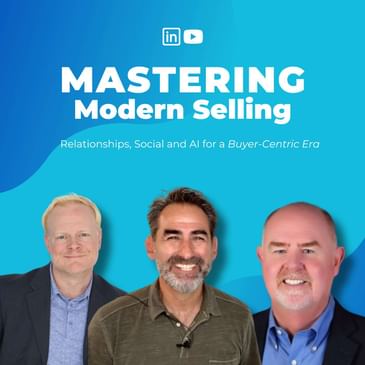
In this episode of Mastering Modern Selling, hosts Brandon Lee, Carson Heady, and Tom Burton dive into the importance of personal branding, reflecting on the lessons learned from the first half of 2024.
They explore the strategies and benefits of building a strong personal brand in today's competitive market.
Key Points:
- Consistency Compounds:
- Carson emphasizes the power of consistency in personal branding, describing how regular and meaningful engagement over time can transform a small influence into a significant impact. This approach not only builds recognition but also establishes credibility and trust within your network.
- Leveraging LinkedIn:
- Brandon shares insights on using LinkedIn effectively to rise above the noise. By posting content daily, engaging with others, and showing genuine interest in the community, professionals can enhance their visibility and create a sense of familiarity among their audience. This consistent presence leads to higher engagement and better business opportunities.
- Personal Branding as a Career Catalyst:
- Hosts discuss how a strong personal brand can significantly impact career growth. Carson recounts how his personal branding efforts have opened doors and created opportunities within his organization and beyond. He highlights that showcasing your expertise and experiences can de-risk hiring decisions and attract new prospects.
- Creating Valuable Content:
- The importance of producing content that resonates with your audience is underscored. Brandon talks about the strategy of generating content from interviews and transcripts, ensuring that the messages are authentic and in the voice of the individual. This method helps professionals share their knowledge without the pressure of constant content creation.
- Building Trust and Relationships:
- The episode highlights that personal branding is not just about self-promotion but about building genuine relationships and trust. By consistently providing value and engaging with your audience, professionals can foster meaningful connections that lead to business growth and career advancements.
The episode concludes with a powerful message about the critical role of personal branding in today's business environment.
Our hosts encourage listeners to take actionable steps towards building their brands, emphasizing that it's not about perfection but about showing up consistently and authentically.
They urge professionals to embrace personal branding as a long-term strategy for success and to leverage platforms like LinkedIn to their full potential.
To dive deeper into the insights shared in this episode and learn more about building a robust personal brand, watch the full episode of Mastering Modern Selling.
Join the conversation and start your journey towards becoming a recognized and trusted voice in your industry.
Don't miss out, your next big idea could be just one episode away!
This Show is sponsored by Fist Bump
Your prospecting partner to authentically fill your pipeline with ideal customers.
Check out our Live Show Events here: Mastering Modern Selling Live Show
Subscribe to our Newsletter: Mastering Modern Selling Newsletter
[00:00:00] Welcome to Mastering Modern Selling, Relationships, Social and AI in the buyer-centric age. Join host Brandon Lee, founder of Fistbump, alongside Microsoft's number one social seller Carson V Heady and Tom Burton, author of The Revenue Zone and co-founder of LeadSmart,
[00:00:19] as we explore the strategies and stories behind successful executives and sales professionals. Dive into business growth, personal development and the pursuit of excellence with industry leaders. Whether you're a seasoned executive or an aspiring leader, this podcast is your backstage pass to today's business landscape.
[00:00:38] This is Mastering Modern Selling brought to you by Fistbump. Everyone welcome to episode number 93. 93 modern selling. Yeah, 93 only seven to 100. Look at that. And is this the first time you've dressed up Carson because you look good? I dress up all the time, Brandon.
[00:01:06] I don't really notice anything different. Is there something different? No, I was going to say this is my normal decor. I literally just got off a prospecting meeting. Is this like the right technique for talking to executives and C-suite? It worked in my case.
[00:01:22] And July 3rd, anything's possible, right? They said send the statement of work. So that's right. We got a great prospecting week, by the way. I just got to tell you, I think a lot of people are, you know, maybe checking
[00:01:35] out, but it's been a gold mine for prospecting and getting meetings for me. So you've gotten more meetings this week than normal? Lots of responses. Yeah, we booked follow ups, booked workshops. It's been amazing.
[00:01:50] You know, I think I think a week like this is a lot like weekends. Executives are still working, but they're not as busy getting tugged and pulled in different areas. So they've got a little bit more time to review things, to read and respond. It's quieter.
[00:02:05] I was talking, you know, when I talk to executives, they always say, like, hey, like holiday weeks are their favorite to work because they can actually get stuff done. There's minimal distraction. So it's a good time to maybe catch somebody while they're in a good mood
[00:02:18] and, you know, talk business. Yeah, that's great. There's a lot more people working Friday, too, than I thought. I thought Friday was going to be like the day after Thanksgiving and everyone was going to take it off. But there's a lot of people I know working on Friday,
[00:02:34] including me. Yeah, I've got several meetings booked for Friday. I actually have a couple for tomorrow. Tomorrow morning. Are they outside of the United States? I got a couple meeting requests from outside the US for tomorrow. I won't be attending. All right. Well, let's get into this.
[00:02:51] So, yeah, hey, it's good to see both of you here and have us all back together. We're guestless this week, which for the first time and I don't know how long, but Brandon Noir was just telling me we have guests for the next two months after today.
[00:03:06] I was trying to get us into like every six weeks, we would go without a guest so that the three of us can kind of talk and regroup and talk about what we're learning, what we're seeing. But yeah, well, that's good. Two months out.
[00:03:19] We've got Daniel Disney lined up for episode 100, like we have them for 50. So seven more weeks. We'll have him on here right around the corner. Yeah. So we want to talk a little bit today about what we have learned.
[00:03:36] And by the way, if you're listening online and you're there, jump in. Love to know where you are and if you're staying cool. Is it hot where you are, Carson? It depends on the day, Tom. You know, we've been seeing temperatures in the 90s
[00:03:52] and then nearing 100 with the heat index. And then we had top down convertible weather this past weekend. I took full advantage of. So you just never know what you're going to get here in the Midwest. Brandon was saying it was very hot and humid down in Atlanta.
[00:04:06] Where yesterday was yesterday was beautiful. It was we had a little bit of a breeze that was light and comfortable. And today it was just hot and sticky. And we lived up to the hot Atlanta term.
[00:04:18] Remind me, Brandon, I'll be in Atlanta here in a couple of weeks. I'll shoot you a note on the details. All right. You'll be here on a Wednesday. We do the show together. That's not a bad idea. There you go.
[00:04:30] Hopefully it goes better than the last time we tried to do a show in the same room. That was interesting. Anyway, I guess you technically yeah, let's get to it. See who's here. Butch is here. That's great. We haven't seen Aloha from Bob, but
[00:04:46] it is it is a day before 4th of July. So let's see what happens. I don't know if we can go forward with the show without Bob. So, you know, all right. It'll be shorter. That's right. With fewer comments. That's right.
[00:04:59] All right. So we're halfway through the year, a little more than halfway through the year. You know, Brandon, why don't we start with you because with fist bump, because you've kind of I wouldn't say pivoted, but you've really kind of learned a lot from working with people
[00:05:16] and change a little bit about even what your charter is on the fist on fist bump. Why don't you take a second and kind of tell us what you've learned and what you've seen and why you changed the charter? Yeah, that's a good question.
[00:05:28] And I'm excited to talk about it and then hear Carson's input on it as well, because, you know, what we've seen a lot is the value of personal brand, especially from a C-suite. And we've we focus that our goal with our customers and we,
[00:05:46] you know, we we we create content with them. And I want to say that intentionally that it's with them. We don't really write words for them. We we bring them in our digital studio. We interview them for two one hour sessions or four 30 minute sessions per month.
[00:06:01] We take their transcripts. We're feeding it into their twin. And so we're taking their words and we're crafting it into messages. But we're publishing for them seven days a week. We're creating articles, newsletter articles for them or blog articles for them once a week.
[00:06:17] We're helping them with the social listening content comments. And the reason is what we're finding is rising above the noise is so important right now. And it's harder for and in Carson, I want to hear you talk about this,
[00:06:32] because you've got the advantages and the disadvantages of a big brand. Right. In smaller companies, they just look at all that as a disadvantage. So how do they rise above the noise? Well, you know, the LinkedIn is a great way to do that.
[00:06:48] But you've got to be consistent and you've got to do it all the time. And that's why we've shifted to doing like the three post a week to doing seven a week. We want them there all the time.
[00:06:58] And our goals are focused for them are we want their everyone in their industry or in their local market, if that's their preferences, focusing on a local market. Our first goal for them is we want people to say, I see you everywhere.
[00:07:13] And that's our first strategy of arising above the noise and being seen, which is our first goal. And then the second goal is that people will say, I feel like I already know you. And I just hung out with James Gilman, who with perimeter office products,
[00:07:30] you know, he has this pushing the envelope show and he's also one of our clients. And he was just telling me story after story of people as he's going about town doing his thing, the people go, oh, my gosh,
[00:07:40] I see you all over LinkedIn and I love your stuff. And he's like, I've never seen him like my post. I've never seen him commented. But when he shows up somewhere, they're like, I see you everywhere. I feel like I already know you.
[00:07:53] And those two things are really important because when people see you everywhere and they feel like they already know you, they're much more likely to say yes when you ask them to do something. Come to our booth, come to an event, meet for coffee,
[00:08:08] you know, respond to my voicemail, whatever it may be. And we've just found that doing that and focusing on that, we're getting much better traction. We're getting more conversations. We're helping them be more successful than we were focused more on sending out more direct messages and sharing value
[00:08:27] propositions and asking for meetings. So I'm going to pause there because that's really been our slight pivot in our on our focus. And it's really been more of like, hey, we need to up your LinkedIn game.
[00:08:38] So we're going to start producing content for you seven days a week instead of three. And at first, they were like, what do you need from me? Like two hours still. We're just going to take those transcripts.
[00:08:51] We're going to keep feeding your twin and we're going to let the twin help us craft messages in your words instead of writing any content for them. I have a lot of questions. I have a lot of questions, but Carson, I'm interested in your take.
[00:09:07] What do you think? Are you seeing the same thing over this first half of the year? Is this? And even in your prospect, the success this week is rising above the noise of giving a competitive advantage. Yeah, that's a great question, Tom.
[00:09:22] And, you know, as we were kind of preparing for this session, you know, I know we were kind of texting throughout the week and, you know, I started thinking about kind of a, you know, key mantra. I loved Brandon's, you know, you know, kind of creating that
[00:09:36] that image where people already know who you are. And I started thinking about like my personal branding journey. Because because again, your personal branding is really all about figuring out what are my unique superpowers and strengths? What am I passionate about?
[00:09:50] What am I conceivably a thought leader in? What's my value prop, my unique value prop? And how do I disseminate that into the world? And there's so many different ways you can do it. You know, YouTube, LinkedIn, Twitter, Tick Tock, blogs, you name it.
[00:10:05] And I encourage exploration of all of those. But as I thought about it, like I thought of like, OK, well, what would my mantra be for this, especially for the first half of the year? And I wrote a post on it this morning. It's its consistency compounds.
[00:10:18] But what that means is I look back at my journey. It's been a 15 year personal brand journey. You know, I came out of telecommunications and advertising and I had to completely reinvent myself as a social seller at age 35 in the greatest tech company in the world.
[00:10:33] I was a nobody. And I was running around with kids that were 10 years younger than me that knew everything about the cloud and tech. And I thought they were speaking another language. But what I did know how to do was how to go out and create content
[00:10:46] based on experiences that I had and was having. And I tell people all the time when I mentor and coach in this space, your experiences matter. They're relevant. Somebody else is having them or has will have them.
[00:10:58] And so you being able and willing to talk about that will resonate with people. The other element of it is the consistency piece showing up every day, like Brandon just said. The biggest learning that I've had around personal branding this year
[00:11:11] is that it feeds every element of what you try to do. You know, I was talking to somebody earlier today, mentoring a colleague and talking to them about the benefit of, you know, leveraging a podcast to maybe meet that prospect that you want to meet.
[00:11:23] You know, somebody may not take your message because you're part of the noise if you show up like everybody else. But if you show up with a unique message or value right out of the gate, then you might have a better probability of getting that meeting.
[00:11:36] The last thing I would say on that front is that when you really think about it, you know, standing out from the noise, showing up differently from everybody else, the probability, the odds of getting some of these meetings.
[00:11:49] You know, everything that we talk about here is all about establishment of trust and kind of earning that credibility. Not everything that you're going to do is going to be perfect. And it's funny, I was watching some old shows of ours
[00:12:01] just in recent weeks, watching some clips, pulling some some stuff and just tinkering with it. And one of the things that jumped out of me was like one of our early shows where we were talking about people getting started. And it's it doesn't have to be perfect.
[00:12:14] You just have to do it. You don't have to do it perfect. Just do it. So going out, find your mediums, talk to your desired target audience, but keep learning and evolving because I would tell you, like all three of us,
[00:12:28] we've radically changed the things that we've done over the years, but always in a way to best meet the people we want to meet. Mm hmm. That's really good. Hey, Carson, you know, you change jobs. Well, within Microsoft, what a year ago now, almost nine months,
[00:12:43] nine months ago. And I had the best year of my entire time here. And it's very specifically because of the way that we're prospecting and going to market and going after new lines of business that this team had never talked to.
[00:12:58] Did you feel, though, when when you took the new job? And I think I know the answer to the question, but you had built personal brand, right, in your previous roles when you moved into here, did you find that that personal brand carried over
[00:13:12] and that you had a head start in that because of the the personal brand? It will go with you forever. You know what I think is amazing? And I in my post that I wrote this morning, I kind of likened it to taking your little snowball of influence,
[00:13:26] which is what I had about 15 years ago, and turning it into an avalanche. Consistency is what compounds. And so, you know, when I meet other sellers, I have people reach out to me within this company, 200000 employees all the time and say, I'd love to connect.
[00:13:40] Love to meet with you. Love to learn from you. And I feel the same way. I've learned from so many people on a daily basis and I assimilate great things that they're doing into my arsenal. That makes me better as a seller, as a leader.
[00:13:53] The other element moving into the new role, you know, you very quickly, you can moneyball it a lot quicker. I was able to very quickly map out, OK, what's the opportunity? What's the addressable market? Who are we going after? What's the conversation? What's the value prop?
[00:14:07] What's the conversation that's going to get these meetings? And that's why we're having so much success in the last two months. My team and I with digital social selling mechanisms, we've opened up 50 net new line of business, C level, BP level, board level conversations that we've
[00:14:23] this team has never had in seven, eight years in two months. 50. It's because of leveraging things like this social selling, automation and AI. And Carson, it reminds me everything you said right there is, you know, we referenced earlier when I was there with you.
[00:14:40] We we tried doing our show live. We have tech issues. But when we're in the Microsoft office there, you and I got to piggyback on somebody's leftover lunch buffet. And as we're walking back to the office, we have food in our hands.
[00:14:52] We come around a corner and this guy goes, Carson! And he's all excited. And Carson's like, I'm like grabbing Carson's drink and Carson's trying to balance his plate. The guy's like excited and shakes his hand. And oh, my gosh, good to see you. And all that stuff.
[00:15:06] We start walking down the hallway and I go, who is that? And Carson's like, I'm not sure. And that happens whether you're Brandon Lee in just about any city in the country or every once in a while when I go into a Microsoft office.
[00:15:18] That happens because of personal brands. Nice. I was in Seattle and this guy walked up to me and said, you know, Brandon Lee, I know you. I've seen you on his show. I love it, man. But that's but that's our point.
[00:15:30] And I know you just I don't have that wide of an audience. But any any business leader, any any salesperson, we have this medium of LinkedIn, a digital and use Instagram, use Facebook, use TikTok. But we have this ability if we're strategic and consistent,
[00:15:51] they can see us everywhere and they could feel like they already know us. And then when we're making those calls or sending those messages, you know that in Carson, I've taken this from you. You say, you know, anything I can do to increase my probability of success.
[00:16:07] And one of the best things that we can do is do people know us? Do they know of us? Do they feel like they know us? That's going to separate us from all the noise. And it gets that higher probability that somebody is going to say,
[00:16:21] yeah, let's talk, create 50 new logos in your account because you've leveraged your personal brand. And there's all the other whether it's selling systems that are in LinkedIn or email or phone calls or events or webinars. It really doesn't matter if they don't know you. They're not coming.
[00:16:40] One is Matt Dixon tells us, you know, de-risking that customer decision is critical. There's a lot of factors that will lead into that. How they feel about you is a big one. Yeah, I'm curious to give Victoria's comment on here that they're talking about personal branding.
[00:16:55] And Victoria has been a guest on our show. She's recently graduated from University of Texas at Dallas and their professional selling department. I'm really curious what those conversations are of personal branding at that level and at that scale and what they're saying the value of it is.
[00:17:13] Because I believe as we're talking today about what have we learned over the last six months and what are we looking at over the next six months and over the next few years? And we've said this multiple times, but it's becoming more and more clear for me.
[00:17:27] Your influence, not being an influencer, but how influential are you to your targeted audience, whether it's this big or this big? How much does your presence there? How many people know you, know of you and feel like they know you
[00:17:44] is going to be the difference of hitting your goals or struggling to hit your goals? Couldn't agree more. And you know, the other element of that, Brandon, is you think about even the career opportunities that can be unlocked.
[00:17:55] You know, I'd be remiss not to point out how personal brand has helped me throughout time where I was in parallel social selling to create line of business relationships that ultimately led to over a billion dollars of land to deals.
[00:18:09] But all the while, I was also being asked to train and coach and teach this elsewhere and became a known entity because of that. So that I was able to de-risk the next hiring manager's decision. It's been hugely impactful in my own career
[00:18:23] because every move I've ever made has been because of relationships and reputation and that reputation piece. You have a lot of control in how you can parlay your personal brand into where you go. Now, the biggest inhibitor is a lot of people will tell you, like,
[00:18:38] I don't feel comfortable, like talking about myself or like tooting my own horn, etc. And it isn't about that. It isn't about being braggadocious. It's about being able to articulate the value and the experiences
[00:18:50] that you've had in a way that it also tells a story to potential hiring managers. They're able to see you and able to say, hey, this person has the relevant experiences and achievements that I envision a successful person having in this role.
[00:19:04] Now, as a hiring manager, you de-risk my decision because I see it's all out there. You know, you've given a C-level pitch. I mean, you can do so much now making video resumes or giving like a C-level pitch or talking about key wins that you've had.
[00:19:19] Those things aren't braggadocious. That's just telling a story that de-risks your next hiring manager's decision. So personal brand has ramifications across everything. And if you're not taking advantage of the opportunities to create, establish and nurture your brand, you're missing out. Can I tell this story real quick, Tom?
[00:19:36] Yeah. So I had a couple of weeks ago, I had a coffee meeting with somebody here in Atlanta and sent me a connection request, you know, hey, we're both in Atlanta. Accepted it. He's like, would you like to get it together for a coffee?
[00:19:49] And I looked and he owned a company and like, yeah, sure. So we meet for coffee and I sit down and I said, so why did you want to meet? And he said, well, I recently bought a Microsoft partner company out of Tampa.
[00:20:03] And as I was doing my research and I'm going on LinkedIn and I'm going to look at this post and that post, I look at a post and then I'd like you commented on it. And I go look at another post and it's like you commented on it.
[00:20:14] He's like, I looked at posts throughout the Microsoft ecosystem and I just kept seeing that you were commenting on things, a lot of things, a lot of different people's posts. So then I went and looked at your profile and I was looking at what you were publishing.
[00:20:28] I realized you were in Atlanta and I wanted to meet you. Why do I give that as an example? Our reputations precede us. The question is, are you showing up? Are you being consistent? And I love how Carson and I talked.
[00:20:45] There's all these tools that can help us do it. But I think problem number one is we got to get over ourselves. You know, we've got to get over the I don't have time. I think there's a big fear factor.
[00:20:56] I mean, I was interviewed this morning talking about, you know, the four kind of false beliefs that a lot of business owners or C-suite have around LinkedIn. And one of them is they say they don't have time, but what they're
[00:21:09] what they're really is I don't know what to do and I'm scared to ruin my reputation. And the other one is I really don't have anything new to contribute into the conversation. And Carson, as you said, anybody at any level,
[00:21:24] if you share what you know, what you're experiencing, what what you're observing, what you're thinking, what you're feeling going on, that's going to resonate with people. And it's just like you would have a conversation with somebody
[00:21:36] except you're doing it in the form of a post and waiting for other people to come in and engage and comment with it. My friend Robert Washington at Microsoft made a post the other day about how he basically was swinging above his weight class,
[00:21:49] going for a role that he technically didn't qualify for. But he ended up getting and, you know, just about going after your goals and being resilient, got two point five million impressions. Like I tried to have a note. I'm like, Robert, amazing. Like you're super inspiring.
[00:22:04] And we've all had stories that are similar like that, where we've gone after something or, you know, got our teeth kicked in and sharing that stuff builds connection. And that's the key element is that you've got a desired audience of some sort, whether it's your target customer,
[00:22:22] target recruiter, hiring manager. If you want to be a thought leader, there's an audience that you want to have a dialogue with and a connection with, you know, make it about connecting with them, experiences that they're having, ask them provocative questions, entice commentary.
[00:22:37] And then to Brandon's biggest point, and this has been a big learning for me this year, comment, go out and comment on other people. Join the conversation because if they're posting things, they obviously want to contribute. And the best compliment you can give is making a comment.
[00:22:53] You know, I've seen two benefits this year and related to rising above the noise, is Brandon, you phrased it. And one is obviously what we're talking about here, getting new prospects and getting people willing to talk to you
[00:23:13] for the first time. But with my software company, as you know, I have a separate show and podcast. We do we do it every Friday. I think we're getting close to 100 episodes on that one as well. And what I find is, you know, I don't post on LinkedIn
[00:23:27] anywhere near as much as you do. But when I get on the phone with a prospect, the quality of the conversation is so much better. And they'll bring up things. What you said on your show, you talked about this or you said this. And what do you know?
[00:23:44] And it's like it's no longer this vendor and sort of, you know, standoffish relationship that's there. The other thing that I'm finding is, is that even if the companies aren't moving forward right away or whatever, we're not getting ghosted.
[00:23:59] So they actually, you know, you hear a lot, right? It's OK to ghost a salesperson or whatever. They're not looking at us like salespeople. They're looking at us as somebody that even if they're not going to do business with us now, there's a relationship and a partnership
[00:24:14] that they don't want to screw up basically and blow up. So I think the quality of the sales process or just the quality of the business relationship also goes up as that personal brand and that rise above the noise goes through. I think that's sometimes overlooked.
[00:24:32] You know, it is. And I think, you know, telling stories helps with this. And, Kirsten, I know you have a lot of them as well. But like so this morning, I had a breakfast meeting with Natalie Bourne. And I've told this story before. Natalie is the person who
[00:24:48] I was at the airport a couple of months ago, pounding away on an email before I boarded my plane and she tapped me on the shoulder. She goes, Brandon. And I looked up and I went, hi. And I didn't know who she was.
[00:25:00] But she's like Natalie from LinkedIn. I'm like, oh, yeah. And she gave me a great big hug. And we talked and she's like, I got to run to my gate. But I have like three of our clients that I need to get introduced to you.
[00:25:10] I said, great. Awesome. And, you know, we had we had breakfast this morning. We talked and it was like, hey, how can we work together? Because our clients need what what fist bump does. We keep telling me, hey, you need to be more active on LinkedIn.
[00:25:23] And it was an accelerated conversation because of my personal brand, the content we produce, our show, my commenting, I think it always comes back to I see you everywhere. And I feel like I already know you, Tom, to what you were saying is those conversations are different.
[00:25:42] You're not starting from, hey, let me figure out how to create some credibility about who we are and what we do. It's like your credibility is already there. That's half the reason they're on the phone with you to begin with.
[00:25:54] And you can move or accelerate that or, you know, jump a few steps. I'll even take it one step further. And you know what I think is interesting? A lot of times we we shy away from the content piece
[00:26:06] because we're afraid of how it might land with some other target prospect. And that's a valid concern. I've actually I've done a lot of philosophical thinking about, you know, hey, a business executive couldn't care less about my thoughts in the sales thought leadership realm.
[00:26:23] In fact, if anything, it would probably be a turnoff. You know, hey, this guy's written a sales book and, you know, I'm either going to show him the door or I'm going to make it really hard for him. And I'm sure there's been cases like that.
[00:26:35] But I will tell you this, the real value sometimes that I can bring to a customer isn't my savvy around technology because I have very little relative to the brilliant people I'm surrounded by. But what I can do is when I can throw my passion and enthusiasm
[00:26:51] and my knowledge around personal branding, what we're doing from a marketing perspective, what we're doing from a prospecting and targeting perspective. And I got a meeting recently through a board member with a head of marketing. And I'm meeting with them to train them on how I'm leveraging automation
[00:27:07] and AI to help that organization. And that's an organization that I support. I'm not going out and trying to sell a product or licensing or anything like that. It's about establishing the relationship. Relationships beget deals. And that's the key element.
[00:27:20] And to figure out what is your unique value prop, how can you leverage your personal brand in a positive way to help these folks that you serve? You know, brand is maybe hurt you in one out of 10 situations, but nine out of ten, it's going to help.
[00:27:34] Yeah. Is the expression, it's not what you know, but who you know true. And if that's true, it just screams volumes to your personal brand. And I know we got these words like personal brand that get in the way, but it's your reputation.
[00:27:49] It's where do you have influence? Who knows you? Who do you know? And we've got this this screen, this LinkedIn thing that's working for us 24 hours a day if we show up and if we're consistent. I want to welcome Bob, because we almost didn't start the show, Bob,
[00:28:05] because you weren't here earlier. So, lo ha. Aloha. And I want to hit a couple of these questions here, starting with William and Brandon, I would like your take on this. Maybe just start. What do you think is the priority, personal brand or corporate brand?
[00:28:21] Yeah, and I love that question. Let me let me first address it this way, William. I think there's there's a false belief with a lot of C-suite and business owners that social is self-promotion. And it's if we think about some of the influencers on Tiktok
[00:28:39] or Instagram or something, sure, they're very, very much self-promoting. But in our business world, it's it's like going to a conference when the C-suite is known at the conference and they walk around and people know them, they shake hands. They you know, it elevates the entire brand.
[00:28:57] I think in the end, the season that we're in where people are fatigued with corporate pitches, they're fatigued with new companies, they're fatigued with startup and new messages and all of that. It's a better, easier, faster, more human way to build brand through the mouth, the C-suite
[00:29:19] that becomes like a mouthpiece for the company. So I think building the personal brand and you look at some startups that have done this really well, they don't have huge budgets, but they have a CEO or one of the founders that takes on like,
[00:29:33] hey, we're going to go use LinkedIn organically. We're going to build this reputation of our company. And the brand grows as the individual person grows. It's actually I love the question, William, because there's a couple of different ways to answer that. And first off, Brandon, you're spot on.
[00:29:51] But I think back about Darren McKee and how he's talked on even our show about how he'd done work posting 1500 consecutive days. And he knows companies that both didn't value what he had built from a personal brand perspective
[00:30:05] and maybe were intimidated or scared by it and tried to limit it. But also those that have embraced it and benefited from it. And I will tell you, I worked for an organization that has embraced mine. And you've got to do it respectfully.
[00:30:16] I think there's room for both. I will tell you, I inexplicably, unexpectedly lost my job twice in the span of a year back in 2010, 2011 and 2012. And it was it was challenging for me because I had no network.
[00:30:32] And I had to learn the hard way that my network was my net worth. And then I had to go out and get these relationships and develop a brand. And I did it. So your logo is going to change. So that's the key element.
[00:30:43] But while you are paid to be an ambassador of a company, it is important that you use your brand for the greater good of that organization. Like today, I find ways and often when you talk to organizations, there's a challenge with sales and marketing.
[00:30:56] They don't see eye to eye. They don't help each other out. I have reached across the aisle, intentionally worked with marketing so many times. In fact, it was marketing that got me in front of our CEO last year to give a speech to represent the voice
[00:31:11] of the sales field for the entire company. Wouldn't have happened without that relationship, but also me intentionally using my brand and the things that I've learned about brand to help marketing and make our company brand better. So be intentional about not only how you're building yours
[00:31:27] because your your brand is going to follow you no matter what logos on your back. But the other thing is being be intentional about how you are actively supporting the brand of your company. And it reminds me to to Williams question.
[00:31:41] I think that, you know, the corporate brand often speaks from a marketing voice. It's it's much more like a billboard, right? It's giving information a personal brand. An individual can speak more from a conversation like the type of content that an individual can create is much more
[00:31:58] conversational and I get it. We publish content, but we also comment. But it's much more conversational where the corporate brand is more billboard. It's like sharing information. I think that's where the opportunity is with that one to punch
[00:32:13] to really elevate both that personal brand and the corporate brand simultaneously. Well, this this kind of I want to get a couple of these questions here. What we're talking about, I think, ties in really well to Victoria's question. She says, what are some of the difference you all
[00:32:28] she must be from Texas have seen with personal branding? It's not you all. Yeah, well, you know, right. OK, yeah, you all have seen with personal branding and smaller companies versus larger companies like Microsoft. You know, I think what you were saying, Brandon,
[00:32:48] it's almost impossible for a small company to have a big corporate brand. It takes years and all of that. But a smaller I mean, a one person company can build a personal brand or can do that. And I'm interested in your take.
[00:33:03] But my take on this is I don't think it's a lot different. I think building a personal brand at Microsoft versus building a personal brand and this bump or lead smart or whatever our smaller companies are. In fact, it might be a bit easier
[00:33:19] because you're not overshadowed with some of the other things there. What's your guys thought on that? Yeah, I mean, regardless, you're going to go through a lot of the same steps. And, you know, this actually touches on another question
[00:33:32] that Victoria asked in the chat, any tips and tricks for building personal brand as someone who is starting in a new organization? Look, I started doing these things when I was at a very small organization. I worked at a couple of small consulting firms
[00:33:45] before making a move to the behemoth. Right. And the steps are very similar, you know, because at the end of the day, you got to find your your unique voice. You know, part of it is self discovery. Like what matters to me?
[00:33:56] What what are my unique strengths, skills, superpowers? What do I want to be known for? What sets me apart from the rest? And so those things aren't dependent on a company. They might be dependent on your unique skill set or on your experiences.
[00:34:11] And that's going to change and accumulate and evolve to, you know, what I what I say today is very different than what I might have posted 10 years ago. Furthermore, you know, the best relationships that I've built at the company that I'm at now
[00:34:24] have not centered around a product or a solution. It's been all about me proactively reaching out, seeking to serve, seeking to add value, looking to build community. And honestly, try to demystify the large organization that I work for.
[00:34:38] You know, a lot of times we're one of the bigger investments that companies make, which might make them prone to not want to talk to a salesperson who just wants to sell them more. So what I've learned to do is if I show up seeking to serve
[00:34:49] and talking about, hey, these are things that you're entitled to because of what you're doing with us. That's how I get meetings. And I don't show up trying to sell them anything. It's hey, let's let's work on, you know, what looks like a win to you.
[00:35:03] All of those fundamentals can be applied, whether you're in a small organization or a very, very large one. And I think the last thing that I would say is, you know, another similarity and another tip and trick. It's all about networking.
[00:35:15] There's a lot of people that I look to network with, and it could be executives at Target customers. It could be people that are a heck of a lot smarter than me that have been there, done that of what I'm looking to do
[00:35:25] or people that are being super, super successful in the game that I'm trying to play. It could also be colleagues that I want to meet so that I can level up. And then it's also going to be other people, players
[00:35:37] that could be a part of the mix that I might want in the boat with me. Could be people in my company, could be partner organizations, could be other customers. So I think the key element is a lot of the same fundamentals
[00:35:50] are going to play a part in creation of brand, nurturing a brand, whether you're at a small company or a large one. Yeah. And I would say tactically, Victoria, here's how we lead our clients. Three key topics.
[00:36:08] Right, that are most relevant to you, your business and your prospect. And then the fourth one is about your humanity. Now, we use the word humanity on purpose and not say personal because you say personal and you get people thinking, what Facebook is that?
[00:36:22] No, no, no. We got to bring our humanity into it. Just like we do in a live networking event. We don't only talk about business. The way that we connect with people is having more of the human conversations. You know, you look I look at Carson right now.
[00:36:38] If I didn't know Carson, I'm like, dude, I love your shirt. What are you doing for Fourth of July? Right. We start talking about you do a lot of fireworks. We're looking for ways to connect at the human level with people.
[00:36:48] We need to translate that and bring it into our LinkedIn activity. So three key topics. There's always some subtopics underneath it, but that keeps you focused. So your content is not like, you know, going off in different places and you confuse people.
[00:37:04] But three key topics and add your humanity. So one of the key things that I think really makes a difference. I know Carson does this really well, is how do you use like more personal pictures or pictures that you take while you're doing your work day?
[00:37:19] You're you meet with somebody, you're traveling, whatever. And then use that picture to add a layer of something that you've learned, observed, think or feel in the business environment. So you're marrying those two together. What's happening here with a humanity piece?
[00:37:39] Other people's humanity wants to connect with humanity like other people. They want to connect with other people. So when you're adding that, you're giving them ability to more easily connect with you. They don't even have to think about the business part.
[00:37:54] But that humanity piece kind of lowers the bar. It humanizes you. And now it's more welcoming for them if all we are is, you know, business message, business message, business message. It's more intimidating for people to do it.
[00:38:07] So when we bring our humanity, we're really opening up the door and inviting people to connect with us at a human level, which is much easier for people to do. And then we add the business value, the information. And again, I like the three. What are you observing?
[00:38:22] What are you thinking and what are you feeling? And Victoria, I don't care if you've been in a job for a month and it's your first job out of college or you're 30 years in the same company.
[00:38:32] What you think, what you observe and what you feel is going on is relevant to any person. And I think in some ways, being younger and just starting out and having the courage to share stuff like that, you're going to get higher level people in your prospect companies
[00:38:49] and name accounts are actually more willing to speak with you because they appreciate you're young. You're working hard. You're trying. You're sharing up, showing up. You're sharing new humanity. It differentiates you from everyone else that's out there that's just hiding behind their titles and only speaking value props.
[00:39:06] And don't let anybody stifle you. Because you're absolutely going to get people that don't get it or don't want to do it, that say, I don't understand. I don't know why you're doing what you're doing. I hate the self-promotional stuff. Look, I get it.
[00:39:19] I absolutely have people that probably like hate seeing my ugly mug show up on their LinkedIn feed every day. But the bottom line, I do it for a very intentional reason. And I do know that it is meaningful to certain people
[00:39:30] where they're able to learn from experiences that I've had or things that I've learned from other people that I'm willing to share and pay forward. So you're not running the same journey. You're not running the same race as some of these people
[00:39:41] that might tell you to not do it or stop doing it or they don't get it. We've run in your race. And I would say if this resonates with you, do it. And your audience, your people are going to find you and resonate with you.
[00:39:55] And yeah, there's going to be some people that they're not for you because they think, oh, I don't like this style. I don't think I've ever told you this, Carson. I do have somebody that told me, like, you know, I don't understand what Carson does on LinkedIn.
[00:40:06] I don't understand his goal. And then, you know what? I never try to explain what Carson's doing. I just go, well, Carson's not for you. And that's OK. Here you go. And that's OK. But not Carson's. Carson's very successful.
[00:40:19] And there's a lot of people that are for him and like what he does and like how he does it. And they learn from him. But you can't be that way for everybody. And it's OK. And sometimes it's hard for us, our self-esteem.
[00:40:30] We want everybody to like us, especially when we're younger. We're in this business trying to make a name for ourselves. And the riches are in the niches. When you get clarity on who you are and you go at it,
[00:40:42] what happens is your audience is going to find you and you're going to find them. And it's going to be a multiplier effect. Hey, let's let's hit Bob. There's a couple of good questions here. I want to make sure we hit that.
[00:40:53] I want to hit Bob's question about our company's more understanding about being a dual agent for both yourself and the company. I was going to say the same thing, Carson. I think it depends. I think there are definitely I think honestly,
[00:41:07] I think there are definitely companies where the paint upon your role in that company and so forth that can be frowned upon or at least questioned. And then there's other companies that and Brandon, I think you're seeing more and more that are recognizing that it's a value add.
[00:41:22] But any particular I would say we're still in the middle. Yeah, that you're you waiting on me. Look, I don't know. I don't know the answer. I've encountered both. But I do think this as. The voicemails are getting more challenged
[00:41:43] because there's so many more in there, the cold calls are increasing, the cold emails are increasing. Standing out and being different is so much more important into what Carson said, like your network, your your network is your net worth. Being you is your unicifier.
[00:42:01] Being you is the only thing that you can bring to the table that's totally unique and not like any everyone else. I do believe as it's getting harder for companies in a traditional sense of everybody play by the same rules, everybody's controlled.
[00:42:16] This is the this is how you can play. Don't step out of the lines. That environment is being more and more challenged to be successful. And what we do see is those that are embracing and empowering their team to go be successful.
[00:42:32] And yeah, there's always the fear, hey, their personal brand's going to get here and they're going to get recruited away. You know what? People don't leave companies, they leave managers. And if they're happy where they are and they're encouraged
[00:42:46] and they're supported and they're they're helping be the best version of them, they're not going to leave for a small increase in pay. So it's I think it's culture specific in companies. And I think those that are getting they're able to embrace it
[00:43:02] and trust and empower their people, they're actually going to they're going to have dividends return on it. Yeah, if you become a company or a manager or a team that is known for leveling people up so that they can go on
[00:43:14] and make more money or whatever, you're you become a destination organization, you become a destination team. So that's a good reputation to have. You can't play the short game. You got to play the long game.
[00:43:24] I think the best answer your question and then I'm going to parlay this into an answer to Mike's question that he just posted. The smart companies are embracing it, Bob, and kind of giving that dual capability. But it's got to have some guardrails because you can't have somebody
[00:43:41] that is going out and then you touch on Mike's question. I mean, Mike, you basically pointed out some of the things that you absolutely have to shy away from or keep in a box. Right. So Mike says, how do you all feel about personal branding
[00:43:55] that can be controversial to the general population for C-suite types like political, social, cultural issues from a personal perspective? Now, I will from time to time talk about my faith, but I'm also very intentional in how I will separate that from my day job.
[00:44:13] And, you know, there are clear ways where you can draw a line. I don't talk about politics on social media. I kind of, you know, I got away from that several years ago. I used to get into political tussles on Facebook. It's not worth it.
[00:44:29] And I think the key element is you don't want to do or say things that are going to tarnish either your personal brand, alienate others or tarnish your company's brand. And so if you're smart and savvy about it,
[00:44:42] I think companies are by and large being smart and savvy about embracing it to that point. You know, I try to operate. I have never once, never once in 10 and a half years at my organization been told you need to pull that down.
[00:44:57] You need to not post that. You can't do that. So the thing is, I mean, as personal branded people, I think you've got to, you know, you've got to you've got a pretty good arena with which to play, but don't do anything to tarnish
[00:45:12] your personal brand, alienate other people or tarnish your company's brand. That's my general rule. Seems like good common sense. Yeah, I think there's there will be some outlier cases where the CEO is very connected to a certain cause and you want to take that on.
[00:45:32] And I'm trying to think of some good examples. I think the the the pillow guy far right wing didn't serve him very well long term, but it was his personal brand and his company brand were kind of all in on one thing. And and it was infused together.
[00:45:50] And, you know, right, wrong or indifferent agree with him or disagree with him, I think, as an example, that was a that was an example where they were very meshed together. I think unless you're very, very clear on who you want to be
[00:46:03] and what you want to do and put a stake in the ground around something controversial like that, it's probably best just to stay away from it. Well, you know, it's interesting the number of questions that we've had today around personal branding is more questions,
[00:46:22] more good questions than I think we've had in any single episode. We've had a lot of comments, but some really good questions. I like Jeff's Jeff's comment on their Jeff Leisure's comment. I think that's worth us talking about.
[00:46:40] Oh, the highest number of impressions is always when I say something even about me, never a business value proposition about 100 X. Wow. OK. So I'm curious what you two think before before I share what I think about it. Is that valuable? I think it's very valuable.
[00:46:59] I mean, I think, you know, showing any type of learning lesson, experience, opportunity for growth, something around mindset, but a story and experience, those types of things really resonate. And I think about people that I follow. What what what do I engage in most frequently?
[00:47:22] And it's a lot of thought leaders that share their stumblings, share their what they perceive to be inadequacies or, you know, kind of their crosses to bear, how they fought through them, overcome them. That stuff resonates. I mean, why do we go to the movies?
[00:47:40] You know, you want to have a connection, but you also gravitate. You know, you have an emotional reaction when you read these posts because it's like, wow, I can relate to that. Those are the types of characters that I relate to when I read
[00:47:54] and when I watch movies and shows as somebody that has some trait or even maybe, you know, an Achilles heel that I share where I can almost like throw myself into that character. And I think we see the same thing when we're following a social feed.
[00:48:08] If I can relate to that, I'll engage. You know, Tom, what are your thoughts? Well, I think I think the key. This is my personal opinion on it, right? I think that the balance to me, if you one plus one can equal three.
[00:48:27] So if you can add a bit of the personal aspect to it, but then tie it back to and I'm not saying 100 percent, right? There may be a post which is 100 percent personal, but I don't think I would make those, you know, the majority of my posts.
[00:48:42] Right. So if I can balance some personal, hey, I'm out for a hike and boy, this was a steep climb. And this reminds me of the business steep climb or whatever. I think tying things together is would be my my approach to it.
[00:48:58] But I also think it does matter to who you are. Everybody's a bit different on what works for them. You know, Brandon, what you works for you is probably not going to be exactly the same. It's going to work for me and vice versa.
[00:49:11] So I don't know that it can be a cookie cutter, cookie cutter answer. Yeah, I agree. And I think what you just said there at the end is probably where my answer would start is like I said earlier, getting your three key business topics and some subtopics,
[00:49:28] but always bringing your humanity into it, because without our humanity, we're just like everyone else. Our humanity is our unique of fire that we bring. And those stories, those pictures, those experience are what make us unique and they make us more memorable,
[00:49:44] especially because in LinkedIn, most people aren't sharing those things. They're they're scared to they're nervous to they don't feel empowered to whatever they're just not doing it. So when we show up and I know Jeff's got some posts with,
[00:49:56] you know, having morning coffee with his wife or doing some things with his dog, what I mean, the fact that I just said that I remember those things. If Jeff was just posting about his company and what they do
[00:50:09] in the fire industry, I probably wouldn't remember nearly as much because my humanity is connecting with his humanity. I'm going to remember the human elements first before I remember the business elements. It's just the way our human bodies, our human brains are created.
[00:50:26] We're meant to be in community with people. And when we show up that way in LinkedIn, more people pay attention to us and we get that. Hey, I see you everywhere and I feel like I already know you.
[00:50:39] And one of the biggest challenges with LinkedIn for most people is they start and they don't get the immediate feedback and they quit. And but then you get, you know, like you go back to the I love the story with James Gilman because he texted me
[00:50:54] on a Sunday morning one time and he's like, oh my gosh, I get this thing. He went to his high school reunion the night before. He's like, it's like I was the prom king. Everyone's like, dude, you're crushing it on LinkedIn.
[00:51:06] I love all the stuff that you're doing. Your show's great. And he's going, I've never seen them like or comment on any of my stuff. They're not going to do it right away. But the more consistent we are, the more of our humanity
[00:51:21] we bring to it and layer it in with our business acumen and our experiences and our value propositions. We just stand out. And it is a reputation. It is a personal brand. And as we talked about at the very beginning,
[00:51:34] the more people feel like they know you, they're much, much more likely to say yes when you ask them to do something. So Brandon, you use the chef's example with his family, I believe, or his dog.
[00:51:46] Does he have does that then grab more mind share of you for you by seeing a post like that versus just strictly a business post? Is that? Yeah, for me, for me personally, in my style, absolutely. For me, it does.
[00:52:00] And I think there are some people out there that will say, oh, I just anything personal I don't pay attention to. You know what? I'm probably not going to be the best fit for somebody like that, because as I've gotten to know myself more and embrace
[00:52:14] because when I first started on LinkedIn, man, I as I say, I hid behind my title. The only thing I published was about the company, about our value proposition, buy our stuff, buy our stuff. We're good at this. And and I also had crickets.
[00:52:27] And nobody cared because nobody cares about you or your stuff. But when you start showing that humanity side, you're giving people opportunity to connect with you. And that's why I always go back to the live environments.
[00:52:40] You know, I see Carson somewhere in a networking event on that shirt. I'm going to be like, dude, that shirt's cool. Why are you wearing it? Or, you know, are you do is Fourth of July your favorite holiday? Whatever. Like I'm going to engage with that
[00:52:53] because I want to connect. I want to get to know him. And in cursing, you said something earlier that I wanted to key on. You said networking, I think when you were giving Victoria some advice, networking, networking, networking, networking, networking, networking.
[00:53:10] Right. It's it's who we know and who knows us. It's not what we know, but who we know. We say those things. And yet our daily lives where we have this opportunity with LinkedIn
[00:53:21] to make sure more people know us and we know more people and we can network. We kick that to the curb because we're like, oh, I've got I got to get my 30 day goals in. Well, the more you network, the easier it is to hit those 30 day goals
[00:53:34] because you've empowered a bunch of people who know you, like you, trust you and want to help you. We're just missing out if we don't pay attention to that. Look at Bob's post here. You must have used AI to create this. This is pretty remarkable.
[00:53:49] But, I mean, that would stick. You're just missing the hashtags. That's right. It's a personalised picture. That's right. A picture of you eating your dinner that was good, that was there. You know what I want? I want to I want to address this real quick.
[00:54:02] And Bob, I may feel like I'm throwing you on the bus and I don't mean to do that. But when I talk a lot about bringing our humanity into LinkedIn and the response is, well, this isn't Facebook.
[00:54:16] It tells me a lot about the person on the other side. And I and I don't Bob, I'm not implying anything. But usually if they go, well, this isn't Facebook. It tells me a lot about that person.
[00:54:25] Tells me that they're not as comfortable bringing their person into business. And that's OK. It's just not my style. But I also think somebody who's not willing to bring their person, their humanity into business, they don't have as many opportunities to connect with people. You got one shot.
[00:54:48] Your value proposition, your business brand, your competitive advantage. That's all you got. But if it's true that people do business with those who they know and they like and they trust and are like them, you're missing out on all that opportunity to find those areas to connect.
[00:55:06] Or more importantly, for other people to connect with you when you don't bring that to the table. Carson, I think Brandon's in the zone today. It's like we missed the brand in the zone. He is there's something in the air. He's on fire.
[00:55:24] You know, and I can speak to that because the pivot that you mentioned, Tom, is what what I've really learned and seen over the last 12 months. But especially as we started looking at this go, how do we help customers better?
[00:55:37] This is what we're finding that works as we're getting C-suite more comfortable and some of them, quite honestly, it was out of desperation. They're like, hey, all the other stuff that we've done for the last 20 years, it's just not producing for us.
[00:55:51] So I'm finally ready to embrace this. Like lead me, help me, guide me. And I tell I tell everybody that, you know, think of fist bump like the bumpers in a bowling alley. You know, what's the worst part about bowling? You're going to go in the gutter.
[00:56:06] What's first about it? Worst part of LinkedIn, you're going to screw up and go in the gutter. Right. So with fist bump, it's like it's the bumpers. We're going to keep you out of the gutter. And like the bumpers, we're going to bounce you.
[00:56:17] So you're always going down the alley. You're always going to hit some pins. You may not get a strike every time, but you're not going in the gutter. And I think that's what a lot of C-suite and business owners need that confidence in, in getting there.
[00:56:31] And our biggest differentiator is ourselves. And if we're not willing to bring that into this powerful tool of LinkedIn, we're just missing out on a very, very powerful opportunity because we're scared. And life is scary. Business is scary. Missing our goals is scary. That is for sure.
[00:56:53] We've got to get to a point now where we're willing to take those risks. Like my team is pushing me now. We've got the you know, we're talking about what are some of the things that are new, I think over the next six months.
[00:57:06] Go on your phone on LinkedIn and click the video and you start looking at the video feed. Now it's going to feel more like Instagram. Guess what? That's the style that's coming into LinkedIn. And we've got to push ourselves to be there if we want the eyeballs,
[00:57:24] if we want the network, if we want the reputation. Sorry, Tom. No, I just think based on the questions and the quality of the questions we've had today, if I look ahead, I think personal brand over
[00:57:34] the next six months is going to be maybe one of the most defining key strategies over the next six months. Clearly more and more people care about it. It's it's and it's going to be all about the ways that people can continue
[00:57:47] to make deposits into the personal brand bank, because those are the things that are really changing. Like, you know, I we were talking about the new role that I took on and just the ways that you can leverage automation
[00:58:02] and AI to help fine tune your approach with keeping your humanity constant in that approach and messaging is making all the difference in the world. And I think you're going to continue to see ways that, you know,
[00:58:14] you can repurpose content with AI and ways that you can take something that was a podcast interview or a video that you did six months ago and then turn it into a new post with a picture next to it.
[00:58:28] Plus an article or a blog with a AI generated image or a personal image. I mean, there's so many the possibilities are endless. But at the heart of it, the humanity has got to be there. I wanted to hit on one of the questions Bob made.
[00:58:42] Do you find that the younger generation has been conditioned by the anonymity of social media so that they have a difficult time being authentic? I think in some cases, absolutely. Yes, that's a super valid. You know, I think about kids now that are on social and they're not
[00:58:56] they're not thinking about it in this way, obviously. They're not thinking about like the value of creating a LinkedIn profile, you know, across the board in high school. But, you know, what's what's great and, you know, Victoria has been very prominent in the chat today.
[00:59:11] I think there's a lot of hope for the future when these skills are being taught in college courses on how people can leverage tools to go out and create brand, create networking. And we're going to continue to learn.
[00:59:24] I mean, this show started 93 episodes ago as social selling for newbies. And it was because it was a concept that I think we were all trying to wrap our heads around. And we continue to evolve. The approaches will continue to evolve.
[00:59:39] And I think that, you know, the younger generation will have a new outlook. They'll have a unique and valuable perspective. But I do believe there will be tools, digital tools that they're exposed at their disposal that they can use to meaningfully connect.
[00:59:57] So personal brand is is the item for the next six months. Is that what we're saying? Do we really think it is the focus of the next of the next six months of modern selling? It's not going to go away.
[01:00:09] I think it'll be a very valuable component, along with what AI and automation continue to bring us and doing it the right way. Yeah. Which we're going to talk some about that in future shows we have coming up here.
[01:00:21] The last thing I did want to touch on was Victoria's other question. She did make a really great question about going over and thinking about personal values and how they play into brands. And I do think that it's really important to call out that, you know,
[01:00:38] this very much fits into what Brandon was just talking about. But it also, you know, your personal values at the end of the day are what you're going to infuse into how you show up and how you do it authentically.
[01:00:49] Butch, you made a great comment in the chat, too. Not everybody is going to like you. And that's the key thing. There's going to be very few people who are going to be there's going to be people that you're going to be for
[01:01:00] and people that are you're not going to be for. But the reality is that you show up authentically, you show up because the people, as Butch said, who like you are the ones that are supposed to like you.
[01:01:12] And those are going to be the ones that you match with, that you connect with, that you learn from, that become a mentor, a sponsor that you gravitate toward and you want to work with and work for. So things happen for a reason.
[01:01:24] Be intentional with your brand, but also be intentional in how you infuse your humanity and your values into what you what you stand for. In piggybacking on that, if you don't show up in LinkedIn, you're not publishing this type of content.
[01:01:36] You hide behind your title and only share about the business. You're not giving anyone else out there the opportunity to discover who you are and connect with you in that humanity level. And you miss out on a ton.
[01:01:51] All right. Well, I think we need to wrap things up and let people get on with their holiday. Sounds good. Carl jumped in with us today. Carl and Mark. Mark Klausen's out there. Yeah, I know.
[01:02:02] And Bob, I see your point was to tell me more than what you had for dinner. I thank you for that. I wanted to use that as an example to talk about what I talked about. But yeah, right. I'm right there with you. Sorry, Bob.
[01:02:18] All right. Any final thoughts before we wrap up here? Great show. Yeah. Great comments, the questions, the engagement. I mean, you know, as these continue, it's just been so great to see the community that that is engaging and knowing, too,
[01:02:34] that people that are in the chats and the comments are connecting with each other and learning from each other. So I continue to be inspired by that. And I got a lot out of even just preparing for the show. It's always good to be reflective of, you know,
[01:02:47] what what what you're learning along the way, how you're evolving. You know, it's it's important to, you know, whether you're succeeding right now or you're stuck in a rut. Look back and, you know, there's been some really great experiences that we've all had that we can learn from.
[01:03:01] You know, sometimes we have to pivot a little bit and evolve. But hopefully we've done some work today to really embellish upon why personal brand is so important and the impact that it's had for us. Yeah. Well said. All right. Well, thanks again, everybody.
[01:03:18] Thank you for all the comments, all the great thoughts. Really appreciate it. Everyone have a great Fourth of July holiday. I want to make sure everybody shows up with 10 digits on Friday. I saw I saw a meme that said there's there's, you know,
[01:03:34] there's probably several hundred people out there who today is the last day that they're going to have all 10 fingers. So be careful out there. Be safe. And until next time where we're going, we don't need roads. Happy Modern Selling.
[01:03:48] Thanks. Thank you for joining us today on Mastering Modern Selling. If you enjoyed this episode, don't forget to subscribe for more insights. Connect with us on social media and leave a review to help us improve. Stay tuned for our next episode, where we will continue to uncover
[01:04:09] modern strategies shaping today's business landscape. Learn more about Fistbump and our concierge service at GetFistbumps.com. Mastering Modern Revenue Creation with Fistbump. Where relationships, social and AI meet in the buyer centric age.