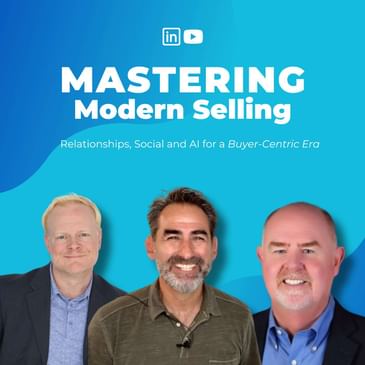
In today's episode of Mastering Modern Selling, Tom Burton and Brandon Lee explore a vital topic: how to drive revenue by cultivating a strong professional reputation.
This is more than just being seen—it's about being trusted, instilling confidence, and demonstrating competence in the marketplace.
Whether you're engaging prospects or working to deepen customer relationships, your reputation is a powerful driver of business success.
- Trust is Built on Consistency and Proximity:
Being consistently present, whether through social platforms like LinkedIn or in person, fosters trust.
It's not enough to show up sporadically—successful sellers stay visible, giving their network reasons to trust them over time.
- Confidence Comes from Consistent Value:
Your audience must not only see you but also find value in what you offer.
Confidence is built when you consistently share meaningful insights, showing deep expertise and an understanding of their needs.
- Competence is Demonstrated Through Expertise:
Sharing high-quality content and thought leadership can position you as a go-to expert in your field.
As Tom mentioned, it’s about proving that you know what you’re talking about—whether through your own content or thoughtful commentary on others' posts.
- Engagement at Scale is Essential:
Digital platforms like LinkedIn provide unparalleled opportunities for scale.
By interacting with a broader audience regularly, you increase your reach and build familiarity, ensuring more prospects see you as a trusted, competent figure in the industry.
- Reputation Precedes Success in Cold Outreach:
Your outreach efforts—whether cold emails or calls—are far more effective when you’ve established familiarity and trust through your reputation.
Without it, you risk being ignored amidst the noise of today’s competitive market.
Reputation is not just a nice-to-have in modern selling—it’s a must-have.
By consistently appearing, adding value, and demonstrating expertise, you build a powerful foundation that drives business.
Don’t leave your success to chance; invest in building your reputation to win trust and close more deals.
Don't miss out, your next big idea could be just one episode away!
This Show is sponsored by Fist Bump
Your prospecting partner to authentically fill your pipeline with ideal customers.
Check out our Live Show Events here: Mastering Modern Selling Live Show
Subscribe to our Newsletter: Mastering Modern Selling Newsletter
[00:00:01] Welcome to Mastering Modern Selling, relationships, social and AI in the buyer-centric age. Join host Brandon Lee, founder of Fistbump, alongside Microsoft's number one social seller Carson V Heady, and Tom Burton, author of The Revenue Zone and co-founder of LeadSmart, as we explore the strategies and stories behind successful executives and sales professionals.
[00:00:24] Dive into business growth, personal development, and the pursuit of excellence with industry leaders. Whether you're a seasoned executive or an aspiring leader, this podcast is your backstage pass to today's business landscape. This is Mastering Modern Selling, brought to you by Fistbump.
[00:00:50] Okay, welcome back. Episode number 109.
[00:00:54] 109.
[00:00:55] 109.
[00:00:56] 109.
[00:00:57] I feel so lonely here. Where is everybody?
[00:01:00] I know.
[00:01:02] No Carson, no guest.
[00:01:04] No Carson, no guest.
[00:01:04] Tom, are we going to be able to pull this off?
[00:01:05] It's just Tom and Brandon today.
[00:01:08] Best show ever.
[00:01:10] Best show ever.
[00:01:11] Yes.
[00:01:12] And if you're online listening, hey, we're going to need your help.
[00:01:15] Jump in and be that third host and be the guest.
[00:01:19] Yes.
[00:01:20] We need comments today, everybody, to keep us going, keep us on track.
[00:01:24] And if you're on the podcast, thank you so much.
[00:01:30] If you like what you hear, we'd love a five-star review or four-star review if that's all you could give us.
[00:01:35] But we love the review.
[00:01:37] And hey, if we add value to you, screen capture that bad boy and then text it off to somebody that you know that could use it and tell them about us.
[00:01:46] We sure appreciate that.
[00:01:47] Hey, Bob's here.
[00:01:47] Bob will keep us on track.
[00:01:49] That's good.
[00:01:49] Bob will keep us on track.
[00:01:51] Aloha, Bob.
[00:01:52] Aloha, Bob.
[00:01:53] Yeah.
[00:01:54] Hey, Brandon.
[00:01:55] So welcome back.
[00:01:56] I know you were out in Montana just a couple days ago, fly fishing, living it up.
[00:02:04] Yeah.
[00:02:05] Sounded like a great, great, great time away.
[00:02:08] Yeah, it was much needed.
[00:02:10] I went with an organization called Help One Now, which is a global ministry that helps people all over the world.
[00:02:21] And they come in and help communities grow from the inside.
[00:02:25] So instead of coming in and bringing food or whatever, they come in and they help equip the local community to take care of themselves.
[00:02:34] And so they train and support and do all that.
[00:02:37] And then we went to a another organization called Refuge, Refuge Foundation out in Montana.
[00:02:45] And it was it was amazing with it.
[00:02:48] Our goal was their goal for us was to turn off.
[00:02:52] And so we turned off our phones.
[00:02:54] We turned out we didn't open our laptops and great conversation with with about 15 other guys.
[00:03:02] And we had options to do whatever we wanted.
[00:03:05] We could sit around and do nothing.
[00:03:06] We could read.
[00:03:07] We could walk.
[00:03:07] We could hike.
[00:03:08] We could fish.
[00:03:10] And so it was a it was a great time.
[00:03:12] But a big shout out to all of them for that.
[00:03:15] So much needed.
[00:03:17] 48 hours.
[00:03:18] Was you like going through withdrawals where you wanted to look at your phone or jump on LinkedIn or whatever?
[00:03:23] You know, it was tough at first.
[00:03:25] You know, it was tough at first.
[00:03:25] But then I went with the mindset when I decided that I wanted to go, that I needed to go.
[00:03:32] Well, actually, my wife and my friend Carl said, like, you're going.
[00:03:38] So I said, you know, you need this.
[00:03:41] So once I decided to go, I'm like, you know what, I'm going to go do it the right way.
[00:03:45] I'm going to go all in.
[00:03:46] So once I once I got there, I got there Wednesday evening.
[00:03:50] Thursday morning, I woke up.
[00:03:52] I responded to a couple of emails.
[00:03:54] I got some things and then I turned everything off.
[00:03:56] And other than occasionally turning it on to text my wife, I stayed off of email and everything until Monday.
[00:04:04] Well done.
[00:04:05] It felt good.
[00:04:05] It really did.
[00:04:06] It felt good.
[00:04:07] I felt refreshed.
[00:04:08] I think we all should end up by, you know, have to go do that for three or four days.
[00:04:13] And I highly recommend it.
[00:04:15] And I highly recommend it to me to keep doing it.
[00:04:17] Yeah.
[00:04:18] All right.
[00:04:18] Well, good to have you back.
[00:04:19] And hey, I want to thank Fistbump for again, helping us sponsor the show, taking care of everything.
[00:04:25] Brandon, I know you have a big webinar coming up.
[00:04:28] We do.
[00:04:29] We do.
[00:04:29] And I'll let everybody know with Fistbump too, you know, not only does Fistbump sponsor and do the webinar for Mastering Modern Selling, but that's what we do.
[00:04:39] We have live show and podcast management and promotion.
[00:04:43] It makes it super easy for us, right, Tom?
[00:04:45] We log in about 15 minutes before the show.
[00:04:47] We talk about the agenda.
[00:04:49] We meet the guest when we have one.
[00:04:51] We do the show for 45 minutes to an hour, and then we're done.
[00:04:55] And the team at Fistbump takes care of everything else.
[00:04:58] So if you're out there and you're in need of a live show podcast, use it for demand generation.
[00:05:02] I would love to talk to you about it.
[00:05:05] That and alongside with our Booth Magnet program.
[00:05:07] But yes, we have a webinar coming up.
[00:05:11] Mark Hunter, who I think Mark Hunter has been a guest on our show three times now.
[00:05:17] The amazing Mark Hunter, the sales hunter.
[00:05:19] He and I are going to be doing a webinar on October 31st, specifically on turning your next trade show into a profit generating powerhouse.
[00:05:31] You know, there's a lot of people we've heard talk about trade shows like, oh yeah, we got to go.
[00:05:36] If we don't make a presence, you know, people think we're out of business, but they're not going at excited.
[00:05:43] They're not looking at it as an investment.
[00:05:44] They tend to think of it as a expense that they have to spend.
[00:05:48] And so we want to show everybody how do you turn your next trade show into a wonderful, awesome, fruity return on your investment.
[00:05:59] I'm really excited for it.
[00:06:01] So we'll do that on October 31st at 3 p.m. Eastern.
[00:06:06] And I don't have the link, but hopefully Noor can throw the link in there.
[00:06:11] I have the link somewhere, but I don't have it in front of me.
[00:06:14] So we'll get it put into the comments here real soon.
[00:06:16] Okay.
[00:06:17] Yeah, it sounds like I'll be here soon.
[00:06:19] All right.
[00:06:19] So I think that's a good lead in to today's topic, which is revenue through reputation.
[00:06:27] I love it.
[00:06:29] You know, we were chatting earlier and kind of talking about, you know, what does it mean?
[00:06:34] Like we use this word reputation, right?
[00:06:36] It's really easy to throw around.
[00:06:38] Hey, you have a good reputation or a bad reputation or no reputation or whatever.
[00:06:42] But the question is, what does that mean in business?
[00:06:46] Mm-hmm.
[00:06:46] And I think what we were, you know, kicking around, Brandon, there's kind of three things,
[00:06:51] right, that make up your reputation.
[00:06:53] And we'd be interested to hear what others think about this.
[00:06:56] But one is, do you have trust with your prospect, your customer, your market?
[00:07:02] Do they generally trust who you are either as an individual or as a company, right?
[00:07:07] As a brand or as a individual.
[00:07:11] Secondly is, do they have confidence in you?
[00:07:14] Mm-hmm.
[00:07:15] So again, whether you're an individual or you're representing your brand, do they have
[00:07:21] the reputation and confidence as a big part of that?
[00:07:23] Do they have confidence in what your product or service is, that you can deliver what you
[00:07:28] say, all of that kind of stuff.
[00:07:30] And then the third part, another C, is competence.
[00:07:34] Mm-hmm.
[00:07:35] Is how competent do they really perceive that you are?
[00:07:38] How knowledgeable, how much experience, how much depth of experience, all of that kind
[00:07:43] of goes into this competence bucket.
[00:07:46] So if you evaluate quote unquote reputation, I think we just do it automatically.
[00:07:53] It's not like we sit here and go, well, I think I trust him and I have.
[00:07:56] But we think about those three things.
[00:07:58] That's what goes through our mind when we evaluate quote unquote a reputation of somebody.
[00:08:04] Do we trust them?
[00:08:05] Do we have confidence in them?
[00:08:07] And especially in business, do we feel like they're competent or knowledgeable in what it
[00:08:11] is that what we're following them?
[00:08:13] Does this seem about right?
[00:08:14] Yeah.
[00:08:15] I mean, I think, look, everybody, Tom is like master distiller and framework creator.
[00:08:21] And so as we've been talking about this, this revenue through reputation, Tom's brain went
[00:08:27] in action and started distilling this down into these three points.
[00:08:32] And Tom, I think you're spot on.
[00:08:34] And I think there's, I think what we should do is spend some talking about how do we get
[00:08:38] that right?
[00:08:39] And I think a lot of people will listen and go, oh yeah, of course, trust and confidence
[00:08:43] and competence totally makes sense.
[00:08:45] But the big question is how?
[00:08:48] And how do we do that?
[00:08:49] And, and one of my favorite things to say, and it's kind of an older, older guy thing
[00:08:54] to say, older person thing to say.
[00:08:56] Um, but I like it is look, nothing has changed.
[00:09:00] We just do it differently.
[00:09:02] And this applies to what we do with these digital or these social channels like LinkedIn
[00:09:08] or other social or YouTube.
[00:09:11] Um, the first step in building trust is proximity.
[00:09:20] Right.
[00:09:20] In the offline world, it was proximity.
[00:09:22] Do you go to it?
[00:09:23] Do you go to a networking event and you kind of see somebody there?
[00:09:26] You go back in another week later, a month later, and you see him again, but, and then
[00:09:30] you run into him like four months later, you run into him at a coffee shop and you look
[00:09:34] at that person and you go, oh, Hey.
[00:09:36] And there's, there's automatically a bit of trust because of that proximity and that consistency.
[00:09:45] And if that scenario that I just explained that I just described is accurate and true, then we should look at that and almost deconstruct it and say, well, how does that pertain to LinkedIn?
[00:10:02] Well, and I, and I want to go, I want to, I agree with you, but let's back up even most of us, right?
[00:10:08] If we're trying to develop a reputation for business, we want to do it at scale, right?
[00:10:13] We want to do it with as many people or many, you know, well, many people as possible that we can that are ideally in our market or, or potentially in the market for what we do.
[00:10:24] Now they could be employee.
[00:10:26] We want to build that with employee candidates.
[00:10:27] We want to build that with prospects.
[00:10:29] We want to build that with partners, everybody in our ecosystems.
[00:10:32] We want to be able to do it at scale.
[00:10:35] But what I'm hearing you say is that that first leg of the stool trust is consistency and proximity are the key elements of that to start building that trust.
[00:10:47] If no one ever sees you or no one ever hears you, it's pretty impossible to build trust.
[00:10:52] Or you pop in, you pop out, you're inconsistent.
[00:10:56] Right.
[00:10:56] Yeah.
[00:10:56] Right.
[00:10:57] And, and you know, in an offline world, I think the scenario I set up makes sense.
[00:11:03] Um, same thing if you go to a couple of trade shows in your industry and you go to the same ones after four or five, six years, people start to go, I've seen you, I've seen you, you've been in the same booth or whatever, but that takes four or five, six years.
[00:11:17] What I love about this, I love about digital and I love about live shows and podcasts and being a host of them is that the frequency is a lot more frequent.
[00:11:29] And there's a lot more opportunities for us to be in the proximity of our ideal customers or of our industry.
[00:11:37] And we can show up multiple times a day.
[00:11:41] So what I like about this is we have a live show and a podcast.
[00:11:44] We go live every week.
[00:11:45] We can publish content every day.
[00:11:49] And my favorite, we can go comment on lots of other people's posts every day.
[00:11:54] And we get to those two key qualitative goals of, I see you everywhere.
[00:12:01] And I feel like I already know you.
[00:12:03] And I think that's the heart of the first step of, of just building trust.
[00:12:09] Yeah.
[00:12:10] Yeah.
[00:12:10] And again, you want to be able to do that at scale.
[00:12:12] So as many people are saying that, right?
[00:12:15] It's not just one person or two people or you're getting that potentially with hundreds or thousands depending upon what you're trying to accomplish.
[00:12:22] And that's where, that's where LinkedIn, YouTube, any other social channels or anything are, for me, they're synonymous with scale.
[00:12:31] Like, I appreciate that you keep bringing the word scale back in for people.
[00:12:35] For me, it's almost synonymous.
[00:12:37] Like, if I say LinkedIn, I'm automatically thinking scale.
[00:12:40] Because I can post and I can look and see, you know, oh, a couple thousand people looked at my post today.
[00:12:47] That's scale.
[00:12:48] I couldn't, very few days in person do I talk to 2,000 people in a day.
[00:12:54] Yeah.
[00:12:54] And that's just one post.
[00:12:56] And then you go, let's say I go and do 50 to 75 comments on other people's posts.
[00:13:01] Well, however many people saw their posts, let's say an average, even if it's on a low end is, is two or three, two to 300.
[00:13:09] But I go do that on 50 other posts.
[00:13:11] Well, now my name, my face, my reputation is getting out there wider.
[00:13:16] So everything that we do in this digital world is at scale, in my opinion.
[00:13:23] So let's move on to the next leg of the stool then, which is confidence.
[00:13:30] So, you know, because you could be out there, right, posting and commenting and doing all those things.
[00:13:37] But depending upon what you're doing, how you're saying it, and whatever, you may or may not be building confidence.
[00:13:43] They may see you a lot, but they're like, I don't have a lot of confidence.
[00:13:46] I don't in them.
[00:13:47] So how do we start to build confidence as part of our reputation?
[00:13:53] Yeah, Tom, I think it's a good topic because I think there's two components to it.
[00:13:58] There is the value of it from or the style of it, I guess.
[00:14:05] And then there's the content, the meat of it.
[00:14:09] So the style, we host a show, you host a couple shows.
[00:14:16] There's some automatic confidence and trust that goes into that.
[00:14:23] But you have to, the quality of your content is what keeps it.
[00:14:27] You can get initially, you know, and we live in this world now where, you know, some people go, oh, you host a show.
[00:14:34] And some people go, oh, so what?
[00:14:36] You host a show.
[00:14:36] Who does it?
[00:14:38] So that alone may or may not, you know, hit the scale with your prospects or whoever you're trying to influence.
[00:14:48] But the consistency in which you do it, because I know a lot of shows, they start and then they don't get beyond eight episodes.
[00:14:57] And there's not a whole lot of confidence in somebody who starts a show and doesn't keep on going.
[00:15:03] But yeah, you've got to have the meat and you've got to have that, you know, the value of the content has to be there too.
[00:15:12] But I do think it is a two-step process.
[00:15:16] Just showing up and turning on a show, there is a bit of credibility that comes with that.
[00:15:22] But then you've got to keep it going so that you get that confidence over time.
[00:15:28] Well, I think it's interesting, the consistency that we talked about earlier.
[00:15:33] If you bridge, we'll talk about competency in a minute.
[00:15:36] But if you bridge consistency between that trust and the competency part of it, right?
[00:15:42] In other words, you see you a lot and I'm competently providing good content, you will get confidence, right?
[00:15:49] But you won't get confidence without the, and I think Bob said it well, right?
[00:15:55] It's easier than, if it was easy, everyone would be doing it.
[00:15:59] Yeah.
[00:15:59] It's not necessarily easy.
[00:16:02] It's consistency and over and over and over and over.
[00:16:07] I know for this show, I know that we started to see, and you can even see it in the quality of our guests and the things that we did.
[00:16:16] We started to get higher quality guests.
[00:16:19] Bigger names.
[00:16:21] Let's say bigger name guests.
[00:16:22] Yeah, bigger names and bigger followings and all of that at about episode 50.
[00:16:32] Right.
[00:16:33] And they wouldn't give us, honestly, they wouldn't agree to be on the show before about episode 50.
[00:16:40] Yeah.
[00:16:41] Right.
[00:16:41] And I think there was a confidence level that, okay, if they've done this 50 times, this must be legitimate.
[00:16:48] I'm willing to invest my time in doing that.
[00:16:51] A lot of these people that we've had on as guests get requests for going on podcasts and shows all the time.
[00:16:57] Right.
[00:16:57] So they're, you know, thinking through the ones that they're doing.
[00:17:01] Anyway, my point being is that consistency is a key part of that confidence piece as well.
[00:17:06] Yeah.
[00:17:07] And I think, you know, we talk about trust, confidence, and competence.
[00:17:12] And all the ways that you earn each of those overlaps.
[00:17:18] There's a proximity and a consistency portion of the trust.
[00:17:23] But there's a consistency and the quality of the content that gives confidence.
[00:17:28] But then there's also a quality of the content and the depth of real like case study material or guests that come on and share their testimonials that gives you that competence value.
[00:17:43] So I believe there's overlap in all three of them.
[00:17:46] And I think the, well, I don't want to go too soon, but I think the key then is, okay, if we're looking at using these digital networks and this content to create demand and build revenue through our reputation, why does all this matter?
[00:18:08] Like practically speaking, why does all of this matter?
[00:18:11] And I think that's an important conversation for us to have here pretty soon.
[00:18:15] Yeah, let's get into, let's finish the kind of the third leg of the stool and then we'll get into the who cares, right?
[00:18:20] Why should I care about this at all?
[00:18:22] Right.
[00:18:22] And maybe we've touched on this already.
[00:18:24] The competence part of the equation.
[00:18:29] That, in my opinion, is really where your content and the quality of your content, I'm going to put air quotes around content, makes the difference.
[00:18:39] But there's two parts of that equation, right?
[00:18:42] There's the content, but there's also the audience that's consuming that content.
[00:18:47] So, you know, the beauty is in the eye beholder, right?
[00:18:49] Some audience may not care at all about the content, even if it's the greatest content ever.
[00:18:54] But the right audience with the right content that resonates for that audience really hits the mark.
[00:19:03] And when you hit that mark, you then start to begin build the reputation of, you know what you're talking about.
[00:19:10] So it's not just I see you everywhere and I feel like I know you.
[00:19:13] You could go one more step and says, and I really feel like they know or he knows or she knows what they're talking about.
[00:19:20] Right.
[00:19:22] Yeah.
[00:19:22] And I think that's super important in business.
[00:19:25] It may not be as important if you're on Instagram or Facebook or socially outside of business.
[00:19:31] But in business, let's face it, we want to invest in time with people that are actually going to help us, we believe, move farther on whatever we need to get done.
[00:19:42] Yeah, for sure.
[00:19:44] For sure.
[00:19:47] Can we get into the so what?
[00:19:49] Okay.
[00:19:50] Do you want to jump into the so what now?
[00:19:52] I think I do.
[00:19:54] Because I feel like, you know, here's why.
[00:19:57] And maybe people listening, they could speak into this as well.
[00:20:00] Throw it in the comments.
[00:20:02] I feel like we beat a bit of a dead horse.
[00:20:07] With building trust, using content and revenue through your reputation and demand creation.
[00:20:16] And it always comes back to, hey, you have to be seen as trustworthy.
[00:20:20] They have to have confidence in who you are and your company and what you provide.
[00:20:24] And they have to find you credible or competent.
[00:20:28] We talk a lot about that.
[00:20:29] And I think it is really important.
[00:20:33] But I think the so what and breaking it down into practical ways is what's really, really important for people to start to take this whole LinkedIn thing a bit more serious.
[00:20:46] Okay.
[00:20:47] So what?
[00:20:48] Why do we want to do this?
[00:20:53] Well, look, I'm going to start at this point, which I think is on the higher level of it.
[00:21:00] But we can keep going down into more tactical and practical terms.
[00:21:04] But when you have a reputation and then you're making cold calls, you're sending out cold messages, or maybe you're even standing in a booth at a trade show.
[00:21:17] When people see you everywhere, they feel like they know you.
[00:21:23] They're that much more likely to return your call, respond to an email or walk into your booth and go, hey, I know you.
[00:21:32] And I don't think over the last decade or so, we've put enough emphasis on that because it became all about the outreach, the cold outreach, the quantity of calls, the tools that we use, the script that we had, the message that we left.
[00:21:49] We were so focused on that that we forgot about the very, very basics of, you know what?
[00:21:56] If the person you're calling has a flipping clue who you are, they're much more likely to return your call than if you're just totally cold out of the blue, but you got a great phone system.
[00:22:07] You have an awesome script.
[00:22:09] You have, you know, all these things.
[00:22:10] We just haven't put as much emphasis on that, I don't believe, overall over the last decade or so.
[00:22:19] So what I hear you say here, or saying here, is when it gets down to it, right, when I'm trying to either generate prospects or generate opportunities or even, you know, work with customers or whatever the case may be, they have to be willing to give me attention, some level of attention.
[00:22:41] Right.
[00:22:41] I have to have some level of mind share of importance with them.
[00:22:45] Some level, could even just be itty bitty, right, of mind share with them, or I'm not going to get the time of day.
[00:22:51] Because how many things are vying for our attention every minute, every day, every day?
[00:22:59] Like when I get off this podcast or this show after one hour and I go look at my email, which I turn off while we're on the show, I'll have probably 15 emails that are spam outbound emails wanting me to buy something or another.
[00:23:16] Yeah.
[00:23:16] Right.
[00:23:17] That's in one hour, probably on average, between 15 and 20.
[00:23:20] And I'm probably not, I'm probably average or even below average compared to what other people get on this.
[00:23:27] So how would I decide if I log onto my email and I scan through what's there, how would I decide even the one that I wouldn't delete and maybe save for later or come back to or whatever?
[00:23:41] It's going to be based on, do they have my attention to some degree and do they have some mind share?
[00:23:48] And as we just talked about, is there some reputation associated with it or not?
[00:23:54] And again, that could be a brand reputation.
[00:23:56] There are certain brands that I will give more attention to because they have a reputation.
[00:24:01] But there's also individuals that I will give more attention to because they have a reputation.
[00:24:09] Yeah.
[00:24:10] And I think, I think a lot of sellers and then even marketers or, you know, whatever expert internally sales and email men that are writing some of these scripts, they think the power of my offer is going to be so awesome that they're just going to start responding.
[00:24:24] And it's bull, like the power of your offer, unless you hit them at just the right time.
[00:24:33] And we've talked about this a lot about, you know, your TAM and what percent of your TAM, your total addressable market is currently even hungry.
[00:24:43] You know, I like, I like using the analogy of the difference between lead gen and demand gen.
[00:24:48] And it's like, you know, when I just went, I went fishing this weekend, but I started using this analogy before.
[00:24:54] And now I really like it even more so.
[00:24:56] But you know, I think you walk up to a lake and you look and it's filled with fish and like, oh my gosh, there's all my fish.
[00:25:02] And so you start throwing your hook out there.
[00:25:05] But what you don't stop to pay attention to is that 99% of those fish won't be hungry for a year.
[00:25:12] And you're throwing your hook all the time going, what the heck?
[00:25:15] My hook is good.
[00:25:17] The bait is good.
[00:25:18] You know, my form, everything is good.
[00:25:20] But they're not hungry for another year because one to 3% of your TAM are currently in market at any given time.
[00:25:29] And I would argue that that number keeps going down because buyers have so many other tools at their disposal.
[00:25:37] They have search, they have social, they have their friends.
[00:25:40] Who in the world these days really, really wants to go to a company website and fill out a form and say, I'm interested and wait for somebody to call?
[00:25:50] So, I mean, it happens.
[00:25:52] It happens for us.
[00:25:53] I'm grateful for it.
[00:25:55] But more than anything, it's the messages that come in that say, so-and-so told me I should get in touch with you.
[00:26:02] Or I've been watching your show for the past several months.
[00:26:05] It's, I'd like to talk to you about a live show and podcast for my company or whatever.
[00:26:12] And that, that's just because that's the way modern buyers behave.
[00:26:16] Like, the opposite is what you just said.
[00:26:19] You're going to get off the show.
[00:26:20] You're going to go turn on your email and you're going to go, oh my gosh, I got 20 things to delete.
[00:26:25] So, do you have a reputation that precedes you?
[00:26:29] And as Carson says, can I have something that'll just give me a little bit more of an increase in probability of being successful?
[00:26:37] Would they pause for a second or go, oh, maybe I'll read that later.
[00:26:41] And then maybe a few days later you do it again and then they pay attention to it.
[00:26:46] But if you're just some cold unknown name they've never seen on social or anywhere else, good luck getting somebody to pay attention to it.
[00:26:55] You know, you just, as you were saying that, you hear a lot about email marketing.
[00:26:59] It's all on the subject line.
[00:27:00] The key is the subject line.
[00:27:02] I don't know about you, but when I go look at that email as I turn it back on, the subject line is not the first thing I will look at.
[00:27:09] I will look at who it's from.
[00:27:11] Right?
[00:27:12] First.
[00:27:13] First.
[00:27:14] I won't even look at the subject line, not to mention the content of the email.
[00:27:18] The only ones that I would normally keep are from somebody again or from an entity or from an individual that I have some reputation with.
[00:27:27] It's not the subject line.
[00:27:29] It's the who it's from.
[00:27:30] Right.
[00:27:31] Which is different because all this email marketing is all about subject line, subject line.
[00:27:36] No, I don't think, I don't know.
[00:27:37] I mean, think about it.
[00:27:38] Next time you go check your email when you wake up in the morning, you have like 50 of those.
[00:27:43] Right?
[00:27:43] Is how are you deciding which of those that you're not going to delete?
[00:27:49] And even if you're not going to take action right this second, you might at least put aside or whatever.
[00:27:55] And we all know sometimes we put email aside and we never get to them again.
[00:27:58] But hey, it's a step in the right direction.
[00:28:00] Right?
[00:28:01] Yeah.
[00:28:02] I would.
[00:28:03] Go ahead.
[00:28:03] I'm sorry.
[00:28:04] Go ahead.
[00:28:04] I wanted to hit Bob's comment.
[00:28:06] Yeah.
[00:28:06] I was thinking with Maslow there.
[00:28:09] So he says people get to the point of appreciating familiarity, but they have to have their most
[00:28:16] immediate problem solved so they have time, room, focus on us.
[00:28:19] You don't have their attention otherwise.
[00:28:22] So I think what Bob is saying here is if somebody's got a big, big ass problem or a big ass situation,
[00:28:31] no matter if they don't have that solved, they're not going to give us the time of day,
[00:28:36] regardless of our reputation.
[00:28:39] What's your thought on that?
[00:28:42] Yeah.
[00:28:43] You know, I think bringing Maslow's hierarchy of needs into this is really interesting.
[00:28:47] And it's almost frustrating for me because it makes so many things out of our control.
[00:28:53] But I think, I don't know, maybe Bob's a little smarter than I am about that.
[00:28:58] I think, and we said, oh, and he said spot on when I triaged my outlook.
[00:29:03] I sort of said.
[00:29:04] Like that word triaged my outlook.
[00:29:05] Yeah.
[00:29:06] It's funny.
[00:29:06] Yeah.
[00:29:07] I, you know, in its, I think subject line is about timing.
[00:29:16] A something in a subject line, if it's, if it's going to hit one of my critical needs
[00:29:21] that has come up, the subject line could capture my attention because I have that immediate need
[00:29:29] to, to what Bob says.
[00:29:30] But most of the time I don't have an immediate need and therefore the sender is going to
[00:29:37] capture more of my attention.
[00:29:39] And I mean, I started doing that this morning.
[00:29:41] I was going through my inbox and checking all the boxes to delete.
[00:29:45] And a lot of, I'm just looking at names going, don't know them, don't know them, don't know
[00:29:49] them, don't know them.
[00:29:49] I don't even care what the subject line is.
[00:29:51] Right.
[00:29:52] If I don't know them, then yeah.
[00:29:59] So I'm not going to pay attention.
[00:30:00] Subject line.
[00:30:01] I know we didn't want to get into email, but I think this is a good example.
[00:30:06] Subject line is relevant potentially if you're trying to capture existing demand.
[00:30:11] Right.
[00:30:12] But if you're trying to create demand, that's going to be a function of reputation over,
[00:30:20] in other words, who you are versus what you're saying.
[00:30:22] Yeah.
[00:30:23] Okay.
[00:30:24] I think that's a fair, I think that's accurate.
[00:30:27] Yeah.
[00:30:27] And when it comes to, look, let's go, I want to go back to my lake analogy with the fish.
[00:30:31] Like lead gen is, oh my gosh, look at all these fish.
[00:30:34] Let's throw the hook.
[00:30:36] And you don't realize that 99% of them won't be hungry for at least a year.
[00:30:41] Demand gen, and it's a silly analogy.
[00:30:43] I get it.
[00:30:44] But demand gen is, you know, you go in the lake and you start setting up videos,
[00:30:48] showing them all the delicious food that they could eat when they're hungry.
[00:30:54] But by the time they're hungry, they've seen it.
[00:30:56] They've seen it.
[00:30:57] They've seen it.
[00:30:58] They've seen it.
[00:30:59] They've seen it.
[00:31:00] They know where to go.
[00:31:01] They know the person's name.
[00:31:02] They know where they're at.
[00:31:03] They know how to find them.
[00:31:05] And so when they are hungry, they don't need to go do a Google search.
[00:31:09] Right.
[00:31:09] They don't need to go look at a Yelp review.
[00:31:13] It's already been conditioned over time that, okay, this is where I'm going to go.
[00:31:20] Is it a perfect analogy?
[00:31:22] No.
[00:31:23] You know, putting videos in the lake for fish is kind of a silly analogy, but I think it plays out.
[00:31:29] So I'm a B2B company.
[00:31:32] I'm a marketing sales organization.
[00:31:36] Almost every marketing and sales organization has two major objectives, generate leads and build brand.
[00:31:44] Mm-hmm.
[00:31:46] Where does all of this fit in?
[00:31:47] Should there be a third category that's a building reputation?
[00:31:53] Should that be a third budget item?
[00:31:55] Or does this fit more under brand?
[00:31:57] Where does this all fit when somebody looks to put this into their sales and marketing budget?
[00:32:03] That's a really good question, Tom.
[00:32:05] And I think it's something that you and I and Carson should talk more about and see and kind of play that out as a framework as well.
[00:32:12] Because I could argue that personal reputation should play into the company brand.
[00:32:18] The challenge there is a lot of companies don't want to invest in personal brand for lots of reasons.
[00:32:25] We've talked about it.
[00:32:27] But it doesn't perfectly...
[00:32:28] I mean, I think in some ways it can fit in as a component of lead gen.
[00:32:33] As you know me, I like to use the term demand generation instead.
[00:32:38] Lead gen for me implies I'm out hunting for buyers who are ready to buy right now.
[00:32:44] And I just...
[00:32:45] For me, I find that is a low probability effort.
[00:32:50] It's high expense, low fruit.
[00:32:53] I had another conversation this past week with the CEO founder of a technology company.
[00:32:59] And, you know, Tom, you're going to laugh.
[00:33:01] You're going to shake your head.
[00:33:02] We've heard the story many times.
[00:33:03] But he said, a board member came in and said, what we need to do for sales, we need to hire a VP of sales.
[00:33:10] We need to let them hire their people.
[00:33:11] We need to start pounding the phones.
[00:33:13] We need a cold outreach campaign because that is going to win deals.
[00:33:19] And he told me at the eight-month mark, he's like, hey, this isn't working.
[00:33:25] You know, give them time.
[00:33:26] These guys are good.
[00:33:27] They know what they're doing.
[00:33:28] And then at the 10-month time, the board member's conversation was, oh, well, we were just testing to see if this would work when it failed.
[00:33:37] And it was a million-dollar expense over 10 years to bring in a sales leader.
[00:33:42] And I think it was eight people.
[00:33:43] And it was a million-dollar expense as a board member said, well, we just tried something.
[00:33:48] The CEO was like, I don't have a million dollars to try things.
[00:33:52] And it didn't work.
[00:33:55] So I just don't like using the word lead gen anymore because I think it's such a fruitless activity.
[00:34:02] And I know that'll get me judged.
[00:34:04] And people want to hang me for it because we still got to make the calls and we got to do all that.
[00:34:09] But maybe I say it this way.
[00:34:11] Lead gen without demand gen, without reputation management, reputation strategy is extremely fruitless.
[00:34:20] Yeah.
[00:34:24] Well, when I was using the word lead gen, I was predominantly using that from a standpoint of not just demand capture, but demand creation as well.
[00:34:39] Right?
[00:34:40] Yeah.
[00:34:41] And I like the way Bob says that.
[00:34:43] Sorry.
[00:34:44] Which one?
[00:34:44] Yeah.
[00:34:46] About the farming and the...
[00:34:48] Yeah.
[00:34:48] Yeah.
[00:34:49] You know, it's...
[00:34:51] I mean, I like that.
[00:34:52] It's about farming in your...
[00:34:55] Service addressable market.
[00:34:56] I would say Tam.
[00:34:57] Yeah.
[00:34:58] You know, he says service addressable market.
[00:35:00] Your total addressable market and limiting your hunting to your SOM, which would be your serviceable, obtainable market.
[00:35:08] I think there's also still a challenge there is how you define obtainable in that, though.
[00:35:14] Is obtainable now or obtainable period?
[00:35:18] I think a lot of that has to do with just timing with your Tam.
[00:35:24] No.
[00:35:26] And I do want to clarify this because I want to move on also to some more tactical things.
[00:35:31] I want to talk a little bit about some trade show type things and other stuff as well.
[00:35:38] But SOM or service obtainable market to me would be these are the people that are in market right now.
[00:35:45] Right?
[00:35:46] That are actively looking or seriously considering purchasing something that you sell, a product or service you sell.
[00:35:55] Service addressable market may have people that are curious.
[00:35:57] They may be curious about it.
[00:35:59] They may be...
[00:36:00] It may have come up, but it's not a priority.
[00:36:02] It's not something that is an actively budgeted item that they're following through on right now.
[00:36:09] But that's the biggest opportunity.
[00:36:11] And we've talked about this.
[00:36:12] We can't control the journey.
[00:36:16] But we can influence that journey that they're going through.
[00:36:20] We can work to turn curiosity into interest and demand.
[00:36:26] We can work to create any awareness into...
[00:36:31] Or no awareness, I'm sorry, into curiosity and then ultimately into demand.
[00:36:36] Right?
[00:36:36] Those are things that we can do in that serviceable addressable market.
[00:36:39] We can't...
[00:36:41] It's like your fishing example.
[00:36:42] I can't just grab the fish and decide that you're going to be hungry right now and tell them you're going to be hungry because I have a kick-ass product that you should buy.
[00:36:51] Right.
[00:36:52] Right.
[00:36:54] Yeah.
[00:36:55] And I think, you know, Tom, one thing I would like to get us to do is we talk about revenues through reputation.
[00:37:07] We've had a lot of pushback.
[00:37:09] And some of the things that I've learned, especially in the past six months to a year, is LinkedIn is a great conversation.
[00:37:19] But it still scares the crap out of people, especially CEOs, C-suite, senior executives about going on and becoming a, you know, my personal brand or becoming a thought leader.
[00:37:33] It's still...
[00:37:36] It creates good conversation and people know all the right things to say.
[00:37:40] But then people are really too scared to implement it on their own.
[00:37:45] It's hard.
[00:37:46] You know, grabbing your phone and doing a video or something like that.
[00:37:49] Or you look at some of the people that are out there that are doing things, you go, I can't do that.
[00:37:53] I don't have the right personality.
[00:37:56] I believe in what we've experienced is a live show and podcast is the best, easiest way to start growing your reputation and using the foundation of a live show and podcast for lots of other outreach activities that we can talk about.
[00:38:19] I think it's one of the best ways to do it.
[00:38:21] And I think, Tom, share your story with your other show around the horn and wholesale distribution.
[00:38:28] And what has that show done for you at LeadSmart over the past year?
[00:38:35] Yeah.
[00:38:36] And I think that's a good...
[00:38:37] I'll go into that.
[00:38:38] I think it's a good example because one of the objections we get, right, when we talk to people about live shows or podcasts is, well,
[00:38:45] I don't want to interview people or I don't...
[00:38:48] You know, they get stuck on a format.
[00:38:51] And there doesn't have to be a format that you have to exactly follow.
[00:38:56] So, you know, the other show that I do is called Around the Horn and Wholesale Distribution.
[00:39:02] And it was kind of a stupid genesis.
[00:39:05] We were doing a newsletter every week to our market that was like, here's the latest news of the week in this industry that we're in.
[00:39:14] Right.
[00:39:15] And Wholesale Distribution has news about, you know, economy, supply chain, technology, all kinds of stuff.
[00:39:21] We were sending out this email or I'm sorry, this newsletter.
[00:39:25] And I said to my partner, I said, why don't we just get on on Friday morning after the newsletter goes out and talk about it?
[00:39:36] You know, let's just talk about the news.
[00:39:38] Had nothing to do with our product, nothing to do with our thing.
[00:39:42] And what we didn't realize was is there was a real demand in that market for a new show, if you want to call it that.
[00:39:52] And it's interesting, the response that we get.
[00:39:54] And I think the last time we looked, we're now getting views every week in 26 countries and literally thousands of people every week that are listening or watching to the show.
[00:40:07] And the reason they said they want to do that is this was a great way every week for them to stay caught up on the news.
[00:40:13] They're so in the weeds during the week, they have a hard time keeping track of what's going on in the industry.
[00:40:18] In an hour or whatever, they can get caught up on what's in the industry and get some insights and stuff along the way.
[00:40:24] That's how we're servicing them.
[00:40:26] But the result of that, I would say in the last year, probably 80% of our pipeline for our product and our opportunity has come directly or indirectly from that show.
[00:40:40] I'm going to pause there.
[00:40:42] Everybody hear that.
[00:40:44] Like 80% of their pipeline has come from that show.
[00:40:49] That's crazy.
[00:40:52] Directly or indirectly.
[00:40:55] And you see, Bob watches most week, right?
[00:41:00] And it's, you know, again, people who are interested in the news of what's going on in that industry.
[00:41:10] It's not about talking about our product.
[00:41:13] We talk relatively very little about our product.
[00:41:19] But when they are, when the fish are ready to eat, as you're to your analogy, right?
[00:41:25] They're going to go, oh, yeah, that Tom and Kevin who does it, we should talk to them first because guess what?
[00:41:31] We have a reputation with them.
[00:41:33] That's all it is.
[00:41:34] Yeah.
[00:41:34] And then we bring it all the way back to the three legs.
[00:41:39] They trust you because they watch you talking about the news or talking about the industry.
[00:41:45] They have confidence because the value of what you guys talk about.
[00:41:49] And granted, you're curating other people's content, but then you talk about it.
[00:41:53] So you're demonstrating your own insights, your intelligence, your history, your experience with it.
[00:41:59] And because you're doing it every time and they log in, they see you as competent.
[00:42:03] And therefore, you are a good and you're a simple answer for them when the question comes up around CRM in their industry.
[00:42:14] And I don't want to dismiss like the qualitative or the anecdotal.
[00:42:22] Bob says he doesn't even know what we sell.
[00:42:24] Yeah.
[00:42:26] I guess we need to do more of that.
[00:42:28] You need to do that a little bit.
[00:42:29] I keep telling you guys need a commercial.
[00:42:31] Okay.
[00:42:31] But the qualitative and the anecdotal value that Kevin says, and I experience this as well, he goes to a show and people walk up to him and go, hey.
[00:42:42] And we call it, you know, it's the mini celebrity effect.
[00:42:45] And it's not to compare ourselves to celebrity, but that's kind of the best, easiest analogy is like celebrities will say they go over and people act like they know them.
[00:42:54] Well, you go to these shows and you're walking down an aisle at a trade show and people go, hey, Kevin, how's it going?
[00:43:01] You're like, hi.
[00:43:03] Natalie, I have lunch meeting with Natalie tomorrow.
[00:43:07] And she's the one I talked about at the Atlanta airport.
[00:43:10] Now I'm working on my laptop and she taps me on the shoulder.
[00:43:13] And at first I had no idea who she was, but she remembered me from the show and remembered me from the show.
[00:43:20] Yeah.
[00:43:20] Kevin, my business partner is at a show right now, literally as we speak.
[00:43:25] And we did a banner, you know, like in your booth.
[00:43:28] So we did a banner that has around the horn on it.
[00:43:32] And he's saying more people are coming and stopping to talk to them because they're, oh, they recognize the around the horn even more so than we have with our own brand.
[00:43:42] But that's okay.
[00:43:43] That's okay.
[00:43:46] All we care about is people willing to have conversations and willing to give the attention.
[00:43:51] And if they're not interested in what we sell or do, that's fine.
[00:43:55] But you know what?
[00:43:55] They may refer somebody or, you know, whatever the case may be.
[00:43:59] Right.
[00:44:00] It's that reputation can lead to a lot of other things.
[00:44:03] Yeah.
[00:44:04] And then, you know, that goes back to, you know, we talk a lot about the KPIs and what are people documenting to prove their worth.
[00:44:13] And, I mean, I think companies need to do a much better job of freeing their marketing team from a lot of the KPIs that they're forced to capture.
[00:44:22] And then, therefore, they're forced to play into those KPIs that actually don't have any value.
[00:44:28] But we focus on conversations.
[00:44:31] Now, we do focus on connections because if you don't have those connections, you're not going to get the conversations.
[00:44:37] But it's connections to conversations, to opportunities, to revenue as the KPIs.
[00:44:43] And what you're saying is you got the around the horn.
[00:44:46] To Bob's point, he doesn't even know what you sell.
[00:44:49] But if Bob was at that show as well and you see the around the horn and wholesale distribution logo, the whole, I see you everywhere.
[00:44:57] I feel like I know you.
[00:44:58] Or, oh, my gosh, these guys are great.
[00:45:00] Where are they?
[00:45:01] Is definitely going to take effect.
[00:45:03] And I'm sure Kevin's having a lot of conversations.
[00:45:05] And that's one of our KPIs, conversations.
[00:45:08] And how many of those can you then skillfully move to an opportunity and into a revenue?
[00:45:14] And I would take that number over how many calls did you make any day?
[00:45:19] Yeah, absolutely.
[00:45:21] That is the, in this day and age, is relevant conversations.
[00:45:26] And you could even go and say, well, what's relevant?
[00:45:28] You could make that a very wide, wide thing.
[00:45:32] But relevant conversations are the most important thing right now in business.
[00:45:36] Yeah.
[00:45:37] Because that's probably one of the most valuable commodities is people's time and attention.
[00:45:42] They're willing to have a conversation.
[00:45:44] Yeah.
[00:45:44] I mean, I had a conversation with someone today who is potentially going to become a partner.
[00:45:51] She has a business in the event space.
[00:45:53] So she helps companies with their trade show booths and all that.
[00:45:56] We have our trade show program that we do on the content side.
[00:46:01] And the conversation was basically, I went and commented on one of her posts and commented
[00:46:08] a couple of times.
[00:46:08] That's how I got to know her and she got to know me.
[00:46:11] And then we sent messages and we scheduled a call.
[00:46:16] But she said today too, she said, oh yeah, I was looking at your LinkedIn profile.
[00:46:20] It was, you know, you have a lot of followers and I saw that you have a show.
[00:46:23] So that reputation that the activity can accelerate that reputation.
[00:46:31] Even if she wasn't following my show live, just going to my LinkedIn profile, seeing the content
[00:46:38] I post, seeing my activity and that I'm a host of a show and seeing how many episodes
[00:46:43] we have.
[00:46:43] She gave me a lot of credibility before we even got on the phone.
[00:46:47] In fact, I would say it was a reason she was willing to get on the team's call with
[00:46:51] me.
[00:46:52] And then during that call, we started talking about what you do, what I do.
[00:46:55] And now she's like, I've got a company, they've got a trade show coming up.
[00:46:58] I think we can partner together to do this.
[00:47:01] And so that went from a conversation to an opportunity, but that opportunity never would
[00:47:06] have came about if I wasn't doing the reputation growth in order to get those conversations.
[00:47:10] So that's the why, why are we doing the reputation?
[00:47:14] Yeah.
[00:47:15] So, Hey, before we, I can't believe we're already 45 minutes into this.
[00:47:20] Um, before we have to wrap up, let's talk a little bit about trade shows because, or
[00:47:28] shows or conferences.
[00:47:30] And, and I have firsthand knowledge of this word for my other company, LeadSmart, the
[00:47:35] other company we were just talking about.
[00:47:37] Uh, we're doing four weeks, maybe five weeks in a row of, of shows, conferences and all
[00:47:44] of that.
[00:47:45] And I know what those are big budget items, right?
[00:47:49] When you get through travel and booth time and not to mention that it takes you away from
[00:47:55] your, you know, other things that you're doing.
[00:47:58] And I mean, it's a very time consuming and expensive process on that.
[00:48:03] And what I, we're seeing is more and more conferences and shows are getting bigger and
[00:48:08] bigger.
[00:48:09] And I think they're super valuable, right?
[00:48:10] Because they're so valuable for that quality FaceTime that it's so hard to get, you know,
[00:48:16] from one zoom meeting to another.
[00:48:18] How do you specifically, I mean, obviously we gave the example of around the horn, but
[00:48:24] you know, we've been doing that for 113 episodes or whatever.
[00:48:28] Now, how would somebody who doesn't have a live show already or a, or a, what can they
[00:48:33] do to start building that reputation to come into these shows with, with as much potential
[00:48:41] reputation and visibility as possible to maximize those dollars that are, that are occurring?
[00:48:46] I like the way you just, I like the way you just teed that up for, for what we're doing
[00:48:51] at fist bump.
[00:48:52] Oh, is that what you're doing?
[00:48:53] I don't even know what fist bump does.
[00:48:55] So I just know they sponsored the show.
[00:48:59] Yeah.
[00:48:59] Hey, look, I think, so let me, let me tell you what we do and then kind of break it down.
[00:49:07] A trade show program for us is a couple of months out.
[00:49:11] We strategize what those interviews would be, but instead of them turning on their own show
[00:49:18] and trying to do it quickly, we bring them on to one of our shows that we use for this
[00:49:24] purpose.
[00:49:24] That's called the trade show show.
[00:49:26] And we have a format of interviews that we call, you know, it takes them through the hero's
[00:49:32] journey, but they bring five to 10 of their team members, clients, maybe it's people from
[00:49:40] the industry and we strategize those interviews.
[00:49:44] And then we put those out organically and social.
[00:49:48] We can put them in groups.
[00:49:49] We can put them behind a paid campaign to a targeted audience or a custom audience of
[00:49:54] people that we highly believe will be attending the show and get that content in front of them
[00:49:59] in an accelerated way.
[00:50:02] So strategic interviews, paid campaigns to a custom list, organic from the company's
[00:50:10] page, organic from the people's personal profiles and go out into groups, LinkedIn groups or
[00:50:17] other groups that people that will be attending the ICP that would be attending the show are
[00:50:23] going to.
[00:50:24] You can do that.
[00:50:27] And I like the model.
[00:50:28] And you and I have just done this with the client, Tom, that we did that before the show.
[00:50:32] And then after their conference, after the trade show, they're moving into now launching their
[00:50:39] live show and podcast so that they have that routinely around the year and stay top of mind
[00:50:45] and stay in front of people.
[00:50:46] So I think that's the key.
[00:50:49] I think with the paid campaign to the custom audience, there's a lot of room there, especially
[00:50:54] with a nine minute interview that create a retargeting account for anybody who's watched over 50%
[00:51:04] of one of these long videos.
[00:51:05] You can put them into a retargeting ad.
[00:51:07] It's a very simple call to action to schedule a meeting at the booth or schedule a meeting
[00:51:13] even before the trade show if you're not going.
[00:51:16] But using those long form videos to help people kind of let people self-identify that they're
[00:51:23] interested in the content.
[00:51:24] And granted, with LinkedIn, you don't get to know who they are, but you can put them into
[00:51:28] a retargeting bucket and then put a very specific ad to them about scheduling a meeting or scheduling
[00:51:34] time to come into the booth.
[00:51:37] I believe it comes down to the content, Tom.
[00:51:40] It always comes down to your revenue through your reputation.
[00:51:45] And if you have to accelerate your reputation because you got a trade show coming up, you
[00:51:51] can do that.
[00:51:52] Yeah, that's what I'm hearing you say, right?
[00:51:54] I'm hearing it's no different than we've talked about all day so far.
[00:51:58] You're just trying to accelerate it and jumpstart it, kind of ignite it on a shorter time frame
[00:52:05] to get the maximum that you can out of the show.
[00:52:08] But then after the show, assuming that it accomplishes what you're hoping, then do more of the
[00:52:13] longer term strategy of a live show in podcast, which is the ideal situation.
[00:52:18] Yeah.
[00:52:19] Yeah.
[00:52:20] And Bob's comment earlier, he said that putting yourself out there takes practice to become
[00:52:25] comfortable with it.
[00:52:27] And if people don't practice it, they'll never achieve it.
[00:52:29] Look, I think becoming an influencer or influential on LinkedIn by doing selfie videos and doing
[00:52:38] creative posts and all that.
[00:52:39] I think there's a very small personality subset that's ever going to do that well.
[00:52:45] I mean, I coached people for a lot of years and it was very, very frustrating for me because
[00:52:51] a very small percent of the people I coached actually picked up and did the activities that
[00:52:58] they really needed to do to move the needle and turn my coaching into something valuable,
[00:53:04] which is half the reason I stopped coaching because it's like one to 2% of people take this serious.
[00:53:10] And that means 99 to 98% of the people don't have a good outcome.
[00:53:14] And then you get blamed.
[00:53:16] And it's not that our coaching was bad, may not have been perfect, but it's not that our
[00:53:20] coaching was bad.
[00:53:21] It's if you don't implement and you're not consistent, it's not going to work, which is
[00:53:27] a whole reason why we started shifting to the live show and podcast management and promotion
[00:53:33] because it's a lot easier for shy people or people that don't really want to put themselves
[00:53:39] out there.
[00:53:39] It's much easier to be a co-host of a show, not to mention the huge value of using your
[00:53:46] show to reach out to your prospective clients.
[00:53:49] I mean, we just, the example was they were calling and calling and calling this prospect
[00:53:57] for like six, seven, eight months, never returned a call, but dropped a call in and said, Hey,
[00:54:03] we would love for you to be guests on our show.
[00:54:05] 13 minutes, the call was returned.
[00:54:09] And if the KPI is conversations, that's a great KPI.
[00:54:14] We just created a conversation.
[00:54:16] We use the structure of a show, but we got the conversation and started to build that relationship.
[00:54:22] Yep.
[00:54:25] No.
[00:54:25] And, you know, I, it leads smart.
[00:54:28] One of the things we're working on going into next year, right?
[00:54:31] As we were spending a lot of time identifying who is the top 500 organizations that we want
[00:54:38] to have conversations with, not sales necessarily five, five.
[00:54:44] What are the top 500 companies that we want to have some conversation with over that course
[00:54:49] of the year?
[00:54:49] If we have conversations, legitimate, relevant conversations with those 500 companies, we'll
[00:54:56] get sales.
[00:54:57] That will happen no matter what.
[00:54:59] We don't have to do anything else along the way.
[00:55:01] But those 500 companies that even if they're not buying something, like I said before, they
[00:55:06] may become a podcast listener.
[00:55:07] They may become a referral source.
[00:55:09] They may become who knows what, right?
[00:55:12] But we now have made 500 friends essentially or acquaintances along the way.
[00:55:17] But the key is, is, you know, we identify, there's in our market, there's, I think, 200,000
[00:55:22] wholesale distributors.
[00:55:23] We're not going to talk to 200,000 of them next year.
[00:55:26] So who are the 500 that we want to talk to?
[00:55:29] Yeah.
[00:55:30] And really getting to know who those are.
[00:55:32] So if you do that and you combine with what you just talked about, you'll get conversations.
[00:55:38] Yeah.
[00:55:39] Yeah.
[00:55:39] I think, I think just to do a little bit of a summary for everybody, you know, revenues
[00:55:46] through reputation means that at scale, you've done some very strategic activity to consistently
[00:55:56] be in front of your industry in a positive way.
[00:56:01] Because it, you know, consistency alone isn't, but something with proximity and consistency
[00:56:07] and the value of your content.
[00:56:09] Some, some case study data or conversations from your customers that come on and share
[00:56:15] their experiences.
[00:56:16] You want trust.
[00:56:18] You want to give them confidence.
[00:56:20] You want to appear competent.
[00:56:22] And that's where your reputation comes in.
[00:56:24] But all that reputation and the revenue through reputation is one of the best ways to create
[00:56:31] demand or accelerate lead gen.
[00:56:36] If they don't know you, they don't know you from Adam, as the saying goes, you're relying
[00:56:45] on a subject line or a well-written email to get their attention.
[00:56:52] And yeah, that's important.
[00:56:53] However, if the data is true and we know it is, Bob can attest to it.
[00:57:00] Only one to 3% of your TAM are currently in market.
[00:57:05] It's just a low quality, low efficient activity.
[00:57:11] A very red ocean.
[00:57:13] Very red ocean.
[00:57:15] Yeah.
[00:57:16] Yeah.
[00:57:17] All right.
[00:57:18] Well, hey, we made it all the way through with no guest and no Carson.
[00:57:22] But Bob, thank you for keeping us honest.
[00:57:25] Great comments.
[00:57:26] It's always.
[00:57:27] Yeah.
[00:57:27] Thank you, Bob, for being there for us today.
[00:57:30] Appreciate that.
[00:57:32] All right.
[00:57:32] Brandon, anything before we wrap up?
[00:57:35] I would say for everybody, October 31st at 3 p.m.
[00:57:39] I think Noor was going to put the link in here.
[00:57:44] I don't know if it's in there or not, but I will come back around and add it in the
[00:57:48] few places that it's here on LinkedIn and YouTube.
[00:57:52] But we'll put that in there.
[00:57:53] So October 31st, 3 p.m., Mark Hunter and I will be leading a webinar that's titled Turn
[00:58:00] Your Next Trade Show into a Profit Generating Powerhouse.
[00:58:05] We'd love to have you come and join us for that.
[00:58:07] Sounds good.
[00:58:08] And I think we're back with guest and Carson next week.
[00:58:11] We are.
[00:58:12] So full house again.
[00:58:14] All right.
[00:58:15] Thanks, everyone.
[00:58:16] Have a good week and we'll see you next Wednesday.
[00:58:20] Bye, everybody.
[00:58:26] Thank you for joining us today on Mastering Modern Selling.
[00:58:30] If you enjoyed this episode, don't forget to subscribe for more insights.
[00:58:34] Connect with us on social media and leave a review to help us improve.
[00:58:37] Stay tuned for our next episode where we will continue to uncover modern strategies shaping
[00:58:42] today's business landscape.
[00:58:44] Learn more about Fistbump in our concierge service at GetFistbumps.com.
[00:58:48] Mastering modern revenue creation with Fistbump, where relationships, social and AI meet in
[00:58:54] the buyer-centric age.