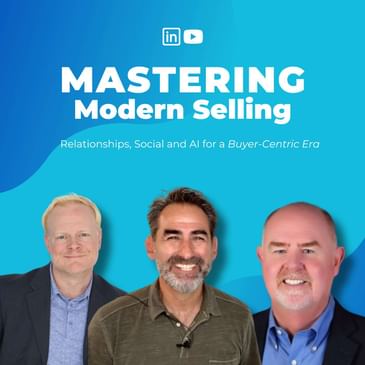
In this episode of Mastering Modern Selling, hosts Tom Burton and Carson V. Heady are joined by Denise Natali to explore how modern sales teams can leverage data to drive superior results.
With the abundance of data available today, it's not enough to simply collect it—sales leaders and reps must learn to harness it effectively.
- The Power of Data in Sales
Denise stresses that in today’s competitive sales landscape, using data isn’t optional—it’s essential.
Sales professionals must learn how to interpret data to uncover insights that drive smarter decisions and improve sales outcomes.
- Adopt a "Moneyball" Approach
Drawing inspiration from the book Moneyball, Denise explains how data can be used to make more precise decisions in sales, just like baseball teams use analytics to pick players.
By focusing on the right metrics, sales teams can identify high-value prospects and increase conversions.
- Sales Tools are Evolving
As technology evolves, so do the tools available to salespeople.
Denise highlights how these tools have become more accessible and user-friendly, making it easier for sales teams to gather, analyze, and act on data, thus improving their decision-making in real time.
- Data-Driven Coaching for Sales Teams
It’s not just about tracking data; it’s about using it for development.
Sales leaders should use data to guide their coaching efforts, offering personalized insights to each team member.
This data-backed coaching helps improve performance across the board.
- Continuous Evolution is Key
The sales landscape is constantly changing, and staying ahead means evolving with it.
Denise encourages sales teams to continually adapt to the tools and data available, ensuring they remain competitive and capable of responding to market shifts.
This episode reinforces the importance of adopting a data-driven mindset in modern sales.
By embracing data, leveraging the right tools, and continuously evolving, sales teams can unlock new opportunities and drive success.
Don't miss out, your next big idea could be just one episode away!
This Show is sponsored by Fist Bump
Your prospecting partner to authentically fill your pipeline with ideal customers.
Check out our Live Show Events here: Mastering Modern Selling Live Show
Subscribe to our Newsletter: Mastering Modern Selling Newsletter
[00:00:01] Welcome to Mastering Modern Selling, relationships, social and AI in the buyer-centric age. Join host Brandon Lee, founder of Fistbump, alongside Microsoft's number one social seller Carson V Heady, and Tom Burton, author of The Revenue Zone and co-founder of LeadSmart, as we explore the strategies and stories behind successful executives and sales professionals.
[00:00:24] Dive into business growth, personal development, and the pursuit of excellence with industry leaders. Whether you're a seasoned executive or an aspiring leader, this podcast is your backstage pass to today's business landscape. This is Mastering Modern Selling, brought to you by Fistbump.
[00:00:49] Okay, welcome back. Episode number 115, Mastering Modern Selling. Tom Burton here with Carson Heady. We're missing Brandon today. He's out jet setting somewhere.
[00:01:02] So, sorry to we will miss Brandon, but we have a yet another great guest, Denise Natalie. Did I spell your, did I say your name right? Your last name right?
[00:01:11] Natali. Just think like the Natali. Merry Christmas.
[00:01:14] Okay. Okay. Oh, man, I'm not off to a good start here. So, Denise, welcome. Hey, before we get started, because we're going to talk a lot today about how to use data and data in sales. Carson, I know, I was so impressed when I saw your book and that's
[00:01:32] said Moneyball on the back. I was like, oh, I had to throw it in there. It's a lot of those things that, and it's, I was reading the other day, I just finished Patrick Bet-David's Your Next Five Moves.
[00:01:45] And what's amazing is that he talks a lot about a Moneyball approach as well. And I think that's exactly where we as sellers and sales leaders need to lean in. So, I'm excited about this episode because of the amount of data that we have at our fingertips right now. You're remiss as a seller or a sales leader if you're not leveraging it to your advantage and to make you better.
[00:02:08] And it's just going to get more, the tools are going to make it more accessible and more usable, right, than ever before. So, it's like, anyway, we'll get into this today. Before we do that, I wanted to, again, thank the Fistbump team for, they sponsor this, they handle all the production, they do everything to make all this go. So, even though Brandon is not here with us today, I want us to, oh, perfect.
[00:02:35] Brandon would be proud. Brandon would be very proud.
[00:02:37] He's probably watching this somewhere. He'll check out the recording later.
[00:02:41] Yeah, he'll start heckling us probably here before too long.
[00:02:44] He may post a bad dad joke in the chat.
[00:02:47] That's right.
[00:02:48] Oh, he says aloha. There we go.
[00:02:50] Bob, welcome.
[00:02:51] Bob, our most valuable commenter.
[00:02:55] Most valuable commenter.
[00:02:57] And Bob can ask some tough questions, Denise. So, be ready. Be ready.
[00:03:01] All right. All right.
[00:03:03] All right. Well, Denise, tell us a little bit about you and your background and kind of what you're doing with data now.
[00:03:09] And then we'll, I'm sure we'll go off into a lot of different directions.
[00:03:13] Yeah, sure.
[00:03:13] So, my background is, you know, like most people, I think I fell into sales.
[00:03:18] That's typically how we all get in here.
[00:03:20] I started my career as an intelligence officer.
[00:03:23] And so, spent the first 10 years of my career using all-source analysis, electronics, intelligence, targeting, all over the world in lots of places, which is kind of neat.
[00:03:36] Learned a lot from that.
[00:03:37] And then once I got out of the military, I was dual military, little kids, bad combo.
[00:03:43] So, you know, I got out of the military, went into finance for a little bit, enjoyed it, but really, really wanted to get back into technology and really being on the ground with it.
[00:03:54] So, got into, I was into telecom for quite a while and learning about networking because that was a natural extension from what I was doing in the military.
[00:04:04] And then from there, just kind of went into strategy consulting a little bit.
[00:04:08] And that was on illustrating digital transformation and helping Fortune 100 companies go from, you know, their large master plan to actionable plans.
[00:04:20] And that was some of the most fascinating work I've done.
[00:04:24] And then most recently, you know, I came back into technology and Data Adobe was a company I had long admired.
[00:04:31] We had used them with some of the companies that I had worked with before and had a great opportunity to pick up the reins and help them to grow and scale here in the U.S.
[00:04:41] What a journey.
[00:04:43] You know, hey, before we jump into data, I want to touch a little bit about what you were saying when you were working with, what did you say, Fortune 100?
[00:04:50] You were working with Fortune 500 companies on kind of taking their visionary plans and making them actionable.
[00:04:56] What were some of the biggest barriers you ran into on that?
[00:04:59] What were some of the things that got in the way?
[00:05:02] You know, some of the things that get in the way of that were things that everybody deals with.
[00:05:07] You know, whether it's having so many silos within an organization and really not having either alignment on what it is that they're trying to achieve from an outcome.
[00:05:20] You know, marrying that up with, you know, personalities and politics and budgets and all the other competing challenges that go on within an organization.
[00:05:29] And then another challenge that we would come in quite a bit at would be helping customers to really understand or helping our clients to really understand where is it that they're intersecting with that customer buying journey?
[00:05:43] Because, you know, that intersection point has changed.
[00:05:46] It's not always at the very beginning.
[00:05:48] It can be anywhere along the lines based on whatever product they're selling.
[00:05:52] So that was a big area that we did a lot of work in.
[00:05:56] So you were helping them predominantly in the marketing and sales aspect or the acquisition or was it all over the place?
[00:06:04] It was all over the place.
[00:06:06] It really depended on the particular requirement.
[00:06:09] You know, for example, we worked with a couple of cybersecurity companies and they were transitioning from, you know, hardware based cybersecurity products to software based.
[00:06:20] And getting the internal teams to understand, hey, here's how the shift is going.
[00:06:25] And then again, where they intersect and how they sell is going to be a little bit differently.
[00:06:29] So that was a big piece of what we're doing.
[00:06:33] Well, Bob says he's drinking out of his CIA mug right now.
[00:06:38] So and Kevin thinks that Bob could replace Brandon.
[00:06:43] So all kinds of drama going on in the chat.
[00:06:47] Oh, I know.
[00:06:48] Holy Hannah.
[00:06:48] Yeah.
[00:06:50] Denise, I want to hear more about how you fell into sales.
[00:06:52] You know, you've got a fascinating career, in my opinion.
[00:06:56] And I think what's amazing to me, too, is when I think about, you know, the broad strokes of a career.
[00:07:03] Often, you know, we accumulate these skills and these experiences that sometimes we're not exactly sure where it's all going.
[00:07:11] But we ultimately wind up parlaying that expertise into what we do.
[00:07:15] And I mean, it sounds like that's exactly what you're doing.
[00:07:18] You know, tell us more about how you, you know, not only fell into sales, but also how you're leveraging all of this wealth of knowledge and experiences uniquely to serve you in your role today.
[00:07:30] Yeah.
[00:07:31] You know, I would say the way I fell into sales was really, I think most folks wouldn't expect that a military officer would be in sales.
[00:07:38] Because that just is not one of the perceptions that you have.
[00:07:42] But you have a lot of discipline, though.
[00:07:47] Arguable.
[00:07:52] So when you're in intelligence, you are selling something.
[00:07:56] You're selling something that is an unknown.
[00:07:59] You're selling an outcome to an audience that may or may not be receptive to what you're doing.
[00:08:06] So you're selling change.
[00:08:08] And in my role, I was selling not only was I working in the technology side, I was also doing a lot on change management, but doing it under an umbrella of being a human intelligence officer.
[00:08:20] And so building the relationships, understanding how do you take all of the information that comes in from different inputs and then be able to translate that and talk to a specific audience.
[00:08:32] So if I was talking to my assets, I had I had to be able to talk in their language and in talk in ways that would resonate with them.
[00:08:43] If I was talking to my combat commanders on the ground, I had to understand really what they were facing, what they were looking at and what reality was for them.
[00:08:53] And make sure that what we're trying to do was really aligning with something that was feasible and reasonable and got them to where they needed to go to achieve the mission.
[00:09:02] So all of that kind of makes it it for me, it made sales a really natural kind of a progression because those were areas where I really excelled at was on the people side of it.
[00:09:14] And and really kind of that that storytelling, which is a big part of literally everything that we do.
[00:09:21] And I think every salesperson out there, first of all, everybody is a salesperson.
[00:09:25] I don't care if you're an engineer in a back room, but being able to tell that story, to be able to construct a vision for people and then help them to get to the next best place, I think is a big part of really what sales is all about.
[00:09:42] Yeah, I made a post on that earlier in the week that I there's there's sales and everything.
[00:09:47] Half the time I feel like I'm just selling my kids to eat their vegetables.
[00:09:51] What I love to Denise, the vantage point that you have to that.
[00:09:55] I think a lot of salespeople don't necessarily understand or think enough about is that change management piece, like to be able to look holistically at the buyer's experience is of infinite value.
[00:10:08] And I think that's where your vantage point is going to be particularly unique, but also valuable, because that's sometimes that's the blind spot for a lot of sellers.
[00:10:18] You know, they think about getting that presentation out there, doing the demo, landing the deal, and then they move on.
[00:10:25] But the reality is, unless you think holistically about the risk to the client and data is such a critical piece of that, you know, to be able to understand the risk, to be able to articulate that, to be able to be truly on the journey and earn the right to be their partner and their collaborator.
[00:10:42] You know, I think that's where the biggest blind spot is sometimes.
[00:10:45] So what I'd love to hear more about, too, is where have you seen your unique experiences really help you?
[00:10:53] Whereas maybe a lot of sellers may have faltered without that or with having that blind spot.
[00:11:00] Where has your unique experience really helped you in the journey where most sellers don't have that?
[00:11:05] You know, I think you talk about this in your book.
[00:11:09] There's your quick plug.
[00:11:10] Because I love there's a lot of really kind of tried and true pieces that are in there that really talk to what you just asked about, which was, you know, where are the areas that I find are where I have done really well and where other people falter?
[00:11:28] Number one is really walking a whole day in the life of somebody else's shoes and really placing yourself literally in what does customer reality look like?
[00:11:41] What does their total environment look like?
[00:11:42] Not just what you're selling.
[00:11:44] So not just if you're selling data management, if you're selling hardware.
[00:11:50] It's more than that.
[00:11:51] It's what is going on in the entire environment.
[00:11:54] And by doing that, what that does is that opens you up to a more holistic view and more perspectives.
[00:12:01] And that's where you can really start to engage with a client and say, hey, you know, yes, it solves for X.
[00:12:07] However, comma, you've got Y and Z out here.
[00:12:10] So let's start to also address those.
[00:12:12] And I think what that does is where that sets up a really successful salesperson is it helps them to really continuously look from a strategic vision, not only what's right in front of them, but also what's coming up down the road that they have to be able to help and truly partner with their customers on.
[00:12:30] And I would say number two, preparation.
[00:12:34] You know, you mentioned discipline earlier, and I kind of chuckled at it.
[00:12:40] Yet discipline and preparing and really, and this is, again, where data comes in, really understanding what that customer environment looks like, because you have a lot of that now.
[00:12:53] You have the ability to really role play and war game out and brainstorm and expand your perception on what the reality looks like and how you want to approach that conversation with the customer.
[00:13:08] Because if you go in day one and all you want to do is pitch, then that's all you become.
[00:13:14] You're a transactional seller and you really don't have any strategic value for that customer.
[00:13:20] And in this case, and especially today where there's so much going on, the world is changing and it's so dynamic that you really do have to be able to be a true technology partner with your customer in order to help both you and drive those mutual outcomes.
[00:13:36] And that's a big thing that I think a lot of people don't see when they're selling is they think, hey, you know, I've got a bag of widgets.
[00:13:42] I'm going to go to these customers.
[00:13:44] I'm going to knock on these doors.
[00:13:46] 20% are going to buy for me.
[00:13:48] 20% lather, rinse, repeat.
[00:13:50] And that's just not thoughtful selling.
[00:13:53] And I think that that's an area where I know sometimes I get frustrated when I've got salespeople or people come to me for advice and say, hey, can you help me out here?
[00:14:03] And yet, when it comes to the preparation, they either don't put in the work or they just don't know how to put in the work.
[00:14:11] And that's a lot of it is they don't know how to get to point A in order to start the journey.
[00:14:17] So those are areas that I see are challenges.
[00:14:20] So let's unpack those a bit from the context of data.
[00:14:24] Because the first thing that you said about walking in somebody or the buyer's shoes, right?
[00:14:30] You know, obviously, Carson, we talk about this for 115 episodes about being the trusted advisor.
[00:14:36] But I think it'd be very difficult to be a trusted advisor if you're not understanding the person who you're talking to and the shoes that you're doing.
[00:14:44] And then I think the second part of it is how do you become a valuable trusted advisor, which you just described, which is preparedness, right?
[00:14:52] Coming in and maybe even having more preparation, more knowledge, more value.
[00:14:58] So you're not just a trusted advisor, you're a valuable trusted advisor along the way.
[00:15:03] How can a salesperson, let's take each of those separately, right?
[00:15:08] So the first one being walking in their shoes.
[00:15:11] How can they best use data?
[00:15:13] What should we be thinking about, even if I can't do it now into the future for that first one?
[00:15:19] Well, I mean, I think that it boils down to really the most basic elements.
[00:15:23] And you're spot on when you're saying, hey, listen, how do we do this?
[00:15:27] Like, what's the first thing you want to do?
[00:15:29] Because if you look at it from a huge one over a 50,000 foot view, there's a lot to it.
[00:15:36] And so you really have to dial that in and start looking at it from different chunks.
[00:15:41] I go as simple as like, I use data to determine like, first of all, who is the person that I'm talking to?
[00:15:47] Who is the audience?
[00:15:49] Because it's normally more than one person.
[00:15:51] And so you map that out.
[00:15:53] And that's where you can really use data.
[00:15:55] You can use your social selling.
[00:15:57] You can use all of the different pieces of where that person intersects so that you get a broader view on who it is that you're talking to and knowing your audience.
[00:16:06] You know, the other part of that is also when I say who, it's also learning a lot more about that company and what that company is trying to achieve.
[00:16:13] And what does their environment look like?
[00:16:15] Again, all of that competitive analysis is out there.
[00:16:18] All of that data is out there.
[00:16:20] These are areas where sometimes it takes a little bit of sleuthing to figure some of it out because, you know, they may or may not have all of that publicly available.
[00:16:30] And then the other part that I look at from a data perspective is where is it that you can find the best intersections with those customers?
[00:16:39] Whether it's, you know, where do they get their news?
[00:16:42] We were talking before the podcast about what do you get from your news?
[00:16:47] How do you make sure that what you're doing is bedded and all the rest of that?
[00:16:51] So what are those sources of information that they go to and then look towards that so that you get kind of that level setting and you're all on a common ground?
[00:17:01] So that's all about what I would consider to be really establishing a baseline for creating a relationship.
[00:17:08] And then, you know, we've talked a lot about relationships and I think relationship selling is exactly what you need to be a trusted advisor.
[00:17:16] And it means showing up.
[00:17:18] You know, it means having patience.
[00:17:20] It means making sure that they can rely on you, that you've done your homework and that you've gone through and looked at a bigger holistic picture of what they're going through so that they don't have to explain their business to you every single time that they talk to you.
[00:17:35] I mean, we all know that that can be a little frustrating.
[00:17:38] I get all my news from memes on Facebook.
[00:17:40] That's the right place.
[00:17:42] I want to say hi to April.
[00:17:44] And also, Denise, you hit on something that's, I think, super important.
[00:17:48] Look, I've talked before on this show about a deal where, you know, an executive would not give me the time of day, made clear he hated vendors.
[00:17:58] And, you know, I ended up going to the board and to the CEO and the CFO.
[00:18:01] They ultimately forced the meeting and even though it was very tense, you know, ultimately just said, like, look, we're just looking for a way to help you win.
[00:18:09] We have all this great intel from your organization that, you know, we know what you're trying to do and we know the challenges that you've been having.
[00:18:17] And we can do this for you.
[00:18:19] Like, give me something I can sink my teeth into.
[00:18:20] We ultimately did it and we won the deal.
[00:18:23] But the underlying element that I've never really talked about, you actually hit on it, Denise.
[00:18:28] And I think sometimes when there is a, you know, a wealth of information that an organization or a team has or what we call tribal knowledge a lot of times, sometimes as sellers, we don't think to ask.
[00:18:40] Or maybe it seems so daunting to get this intel that maybe we just look the other way and we just go to what's easy.
[00:18:47] I've had a lot of success both on that deal, but also on others because I learned from that deal that there's an immense value.
[00:18:55] And, Bob, you've made some amazing comments in the chat about the value that we bring as sellers.
[00:19:00] There is amazing value in leaning in with executives to say, hey, we would be willing.
[00:19:05] We want to invest the time to spend with your organization, with your teams to get that day into life.
[00:19:11] Because if we don't do that, how else are we going to be able to really make a prognosis, make a recommendation?
[00:19:18] And in multiple cases, we've been able to do that, understand the key elements of the processes, the things that had to exist, the things that maybe were the nice-to-haves, want-to-haves.
[00:19:29] And then how do we kind of customize this bolt-on ideal application to do all the things that they want me to do, consolidate on one platform, et cetera, so on and so forth.
[00:19:43] So there's an immense value in being available, but also doing the things that other sellers won't do.
[00:19:52] Mm-hmm.
[00:19:54] That's exactly it.
[00:19:55] You know, it's a lot about making sure that you've got that total environment.
[00:20:01] And, you know, I'm seeing some of the notes in here that, you know, it does take time to be proactive.
[00:20:07] It does take time to, you know, do what I would consider to be the business-as-usual things, which is, you know, there were some comments in here about, yeah, leaders are always asking for data and the numbers and all the rest of that.
[00:20:20] But one of the questions I used to ask my salespeople was, what would you do differently if you were sitting in my seat?
[00:20:27] Ooh.
[00:20:29] And, you know, when your VP is asking you that, and I'm not asking it to be snide or sarcastic, it's, I would, I definitely want to know because just like you manage your customers and manage the, you want to know everything about what a day in the life looks like for them, that's also similar to your own internal customers.
[00:20:49] You have to understand what your internal customers need in order to make sure that, you know, everybody's kind of rowing in the right direction and that there's alignment.
[00:20:59] Because, you know, I have numbers I'm responsible for.
[00:21:03] I've got financials that I've got to make sure are, you know, accurate and forecasts.
[00:21:08] I have a comic about forecasts being fantasy.
[00:21:11] You know, you want to make sure sometimes that you've got the right pieces in there so that your leaders can do their job and then you can continue to do what you need to do and why you were hired, which is you're hired for your skills and your ability to make those connections in order to create those relationships.
[00:21:29] And to really connect what your customers' desired outcomes are with the products and services that you sell or Carson, I know that you've said this before in other places, you know, or connect them to somebody who can do that.
[00:21:44] You've got to be that whole, really holistic broker that brings the resources to your customers because, you know, if I don't do it, then I'm not going to leave a gap there for a customer.
[00:21:58] That's even if it's a if it's a competitor, it's like, hey, listen, I'm not the best fit for this.
[00:22:05] Here's two or three other resources you might want to look at.
[00:22:08] All of that means that there's you know, we go back to preparedness.
[00:22:12] A lot of that is making sure that you as a seller are as prepared so that, you know, if you're not really good at something, you also know who else is and you know who can fill that gap.
[00:22:23] So from an advisor, trusted advisor perspective, it's it's a lot.
[00:22:30] I mean, if sales was easy, everybody would be, you know, out there selling and we'd all be great and successful.
[00:22:36] It's not. It's hard.
[00:22:37] It's hard because there's so many moving pieces and it's such a dynamic environment that you always have to be on.
[00:22:45] And that's why, you know, there's a lot of skills that you learn when it's how do I manage all of this information?
[00:22:52] How do I manage my time?
[00:22:54] How do I manage these relationships?
[00:22:56] How do I manage emotions?
[00:22:58] You know, all of that is is an essential part of being a salesperson.
[00:23:03] You know, my better half is a is a surgeon.
[00:23:05] I would never even want to understand how to do all of that because those are areas where, you know, that's just not what my skill set is.
[00:23:15] You know, and these are areas that, again, I think that from folks that are in the sales in the sales world, these are kind of the key and essential skills that you have to have.
[00:23:26] Like just like my my better half is not going to.
[00:23:29] He's got to always be up on what are the latest infectious diseases?
[00:23:33] What's going on in, you know, patient care and control and software?
[00:23:38] He has to do all that as well.
[00:23:40] And those are just the skills of his trade.
[00:23:42] These are the skills of our trade, which is we always have to be sharp on intelligence.
[00:23:47] Man, exceptional content.
[00:23:49] I know, Tom, I know we want to hit Bob's comment.
[00:23:51] I want to make a statement, too, that will kind of maybe plant a stake in the ground on something else we can talk about.
[00:23:57] And Bob also, Bob, you're on fire today for making the miracle on 34th Street reference in the chat.
[00:24:05] Be the Macy's Santa.
[00:24:06] Be the Macy's Santa.
[00:24:07] Provide what the customer needs, know where to send them.
[00:24:10] God, beautiful.
[00:24:12] We need to talk, too, about sales leadership.
[00:24:16] And I think a lot of times the challenge is created when you've got a sales leader that doesn't know what to do with all of this data.
[00:24:22] You know, they've got a voice from above that's putting pressure on them, perhaps.
[00:24:27] They don't know exactly how to manage up.
[00:24:29] They don't know exactly how to show.
[00:24:31] You know, they're almost like showing up to their team because they're not plugged in.
[00:24:34] And they, you know, they're asking for updates that, you know, it's taking up their team's time and taking them out of the field.
[00:24:40] You know, I want to talk about how to be a responsible sales manager with data.
[00:24:44] But, Tom, let's hit that comment.
[00:24:46] Well, yeah.
[00:24:47] And what you're so let me bring up Bob's comment.
[00:24:49] But I think, Carson, to what you just pointed out, there may be a couple of questions here.
[00:24:54] So what Bob's saying is data is highly dependent on the quality of the data.
[00:24:59] Garbage in, garbage out.
[00:25:01] Applies too often.
[00:25:02] I find companies have very poor data quality.
[00:25:05] And that has led to companies going astray.
[00:25:07] I think there's two things I'd like to hit on there.
[00:25:10] One is, Denise, what can we do to improve the quality of our data?
[00:25:15] I know that's a big area that you're looking at.
[00:25:17] But, Carson, what you just brought up is, you know, there's quantitative data and there's qualitative data.
[00:25:23] And a lot of times the manager wants that quantitative data, right?
[00:25:26] What's the number?
[00:25:27] What's the, you know, we all want that prediction.
[00:25:30] Or our favorite when they show up on a call and there's some obscure gotcha question that comes at you that nobody's ever looked at this report ever.
[00:25:39] And it's like, why is it that for the third quarter you only had one of X and everybody else had blank and you've never heard of it before?
[00:25:47] But I digress.
[00:25:49] Did something like that happen?
[00:25:50] Or do I get the impression that's happened to you before?
[00:25:53] No.
[00:25:53] Okay.
[00:25:53] You just heard somebody who had that.
[00:25:55] I heard a rumor.
[00:25:55] So, Carson, did you answer that with a question, which is, why is that important?
[00:26:02] I wish I had asked that exact question back.
[00:26:05] But, no, I think I came up with something that sounded really sophisticated in policy.
[00:26:11] I didn't know what I was talking about.
[00:26:15] But, yeah, but going back to that, you know, again, let's go back to Bob's comment, the garbage in, garbage out.
[00:26:20] How do we do that?
[00:26:22] But I do think there's an important point because, as we talked about here, we're working a lot with qualitative data when we're working with the buyer journey and the different groups that we're.
[00:26:33] And then we have to somehow translate that and put it into a machine and get that out to the qualitative that we can actually provide for prediction and forecasting.
[00:26:41] But, anyway, let's talk about the garbage in, garbage out and how we can improve that.
[00:26:47] Yeah.
[00:26:47] You know, interestingly enough, I'm going to go back to my roots here.
[00:26:53] As an intelligence, whenever we would get a piece of information that would come in.
[00:26:57] So, we look at the garbage in, garbage out.
[00:27:01] You would have to go in and correlate that and compare that to other sources.
[00:27:04] So, if everything I got came in from human intelligence, you know, people on the ground, whisper campaign, whatever you want to call it, I'd have to corroborate that.
[00:27:15] So, I'd have to corroborate it either with something on electronic intelligence or maybe there's an imagery or something along the lines where we could get in and do, I think, a better intersection that says, all right, how true is this?
[00:27:30] You know, and there's been hundreds of books written about, you know, failures in the past or like big successes.
[00:27:36] Typically, you don't hear about the big successes in Intel, which is good.
[00:27:40] But, I think that that translates very directly into what you're asking about here, which is how do you go against the garbage in, garbage out?
[00:27:49] Is you've really got to be able to corroborate a lot of that information that's coming in.
[00:27:53] If somebody says, you know, I'm seeing this like, hey, this person has a thousand activities logged in Salesforce.
[00:27:59] You know, it's an inspection piece.
[00:28:01] And that's where the leader comes in and says, all right, you know, as I would say to my guys, like, is this fact or is this feeling?
[00:28:09] Because, you know, give me that temperature reading on it.
[00:28:14] Because you have to be able, as a leader, you have to be able to give them the safety to give you an honest answer.
[00:28:19] And I think where people get trapped and where you start to see a lot of garbage going in is when they don't feel safe to say, hey, you know what?
[00:28:29] I only had 10 activities logged this week.
[00:28:32] But let me tell you about those 10 activities.
[00:28:35] I know I'm supposed to have 100 or whatever.
[00:28:37] You know, those are areas where I think that as a leader, you can create a safety that lets people be completely honest with you.
[00:28:46] You know, I'll tell my guys, like, listen, this is a two-beer conversation.
[00:28:50] So first beer says you're going to tell me what I want to hear.
[00:28:53] Second beer is you're going to tell me what I need to hear.
[00:28:56] So tell me what's really going on with what you're putting into the system, if it's in Salesforce or into our CRM or, you know, whatever you're getting from a customer that says, hey, the customer is telling me this.
[00:29:09] How do you inspect that?
[00:29:10] You're like, well, what else is going on?
[00:29:12] How do you get your questioning to really start to expand and give you a broader view rather than just a really narrow kind of an alley view on what's going on with the customer?
[00:29:26] I think April's got a few really good comments as well that I think also kind of speak to, like, the realities of today's sales world.
[00:29:35] You know, we've got a lot of sellers out there that are getting, you know, pinged, asked regularly, whether it's in one-on-ones or sometimes put on the spot in team meetings that, you know, hey, like, show me your activity.
[00:29:52] I have a lot of thoughts on this.
[00:29:54] And, you know, just like I've been in sales for a long time.
[00:29:58] So, I mean, I've had every, I've run the gamut from, like, great leaders who trusted me, greenlit me, let me go run free.
[00:30:04] And I made them a lot of money.
[00:30:07] And then I've also had some awful managers that have nickel and dimed me, pulled me into daily excruciating pipeline reviews, encouraged me to create fluff to make the pipeline look better than it was.
[00:30:23] And then, of course, brought down the hammer when a deal didn't come through that they wanted me to commit that I didn't want to commit.
[00:30:30] I mean, I think through a course of career, like I'm going to go a little philosophical here, through the course of a career, you're going to have some managers that just don't know what they're doing and also can't handle the pressure from above.
[00:30:43] You know, I've reached a point in my career where I'm pretty confident in my approach, in my business.
[00:30:50] That wasn't necessarily the case, like even 10 years ago when I was an account executive for the first time.
[00:30:55] You know, I had a very distinct early career in telecommunications and advertising sales.
[00:31:00] I was very successful.
[00:31:01] And then that ended.
[00:31:03] And then I had like the second career in technology.
[00:31:07] And my first year as an AE is very challenging.
[00:31:11] I believed that this social selling process would work.
[00:31:14] But at the time, I didn't have the results to back it up.
[00:31:16] And so I, like April's comment, was getting a lot of what are you doing?
[00:31:22] I don't understand what using LinkedIn has to do with your, you know, your outreaches and your touches and your contacts and CRM and all of this jazz.
[00:31:33] And I mean, I was just doing what I believed was going to be right.
[00:31:36] My first year, I got put on a performance plan.
[00:31:38] I got graded insufficient results, no rewards, no commissions.
[00:31:43] I was a foot out the door.
[00:31:44] Most people at that stage, you're done.
[00:31:47] I believed in what I was doing.
[00:31:49] I became an ultimate consummate student of the game.
[00:31:52] And I got really ruthless.
[00:31:53] I applied what I like to call ruthless discipline to my schedule.
[00:31:56] I picked up that term from Megan Reed, who I interviewed on a podcast a couple years back.
[00:32:01] Got to give credit where credit is due.
[00:32:02] And I just did away with all the fluff in my schedule.
[00:32:06] And I just became obsessed with execution of process, with customers at the heart.
[00:32:11] And it worked.
[00:32:12] And it became overwhelmingly, you know, obvious that what I was doing was working.
[00:32:16] I won company award after company award, got promotion after promotion.
[00:32:20] So at this stage in my career, I finally got to the point where people let me do my thing.
[00:32:24] But until you go through that almost excruciating rigor, sometimes you're going to still be beholden to some of these managers that are going to look for the activity.
[00:32:34] And challenging them is not something that a lot of us necessarily have the wherewithal sometimes to be able to do.
[00:32:40] So I've gone in and, I mean, sometimes I've had my CRM up literally while I was an individual contributor, while I was on the call with customers.
[00:32:48] And I would be making the notes while I was talking.
[00:32:51] Fortunately, God gave me a couple of skills, one that I can type very fast.
[00:32:56] And so, like, I'd be making these notes and, like, shipping this stuff off and creating these opportunities while I was on the calls because I was back to back.
[00:33:04] I mean, I was slam busy.
[00:33:05] I'm not like a lot of sellers.
[00:33:08] I'm not great at the administrative stuff.
[00:33:11] I like to do the activities.
[00:33:13] But I think there's always going to be managers in the world that will look at your results and your process and pick holes no matter what.
[00:33:24] And we got to have a thick skin for that type of stuff.
[00:33:26] We ideally have the results to back up the way we're doing it.
[00:33:30] And sometimes we got to smile and nod and say, you know what?
[00:33:33] Thanks for the coaching.
[00:33:34] Thanks for the guidance.
[00:33:35] I learned that a long time ago.
[00:33:37] Sometimes I just need to keep my mouth shut, keep my head down, keep executing.
[00:33:41] Because if you make the number, you make the money, you make the result, it has a way of alleviating some of the pressure.
[00:33:48] But there's always going to be pressure.
[00:33:50] And as Doc Rivers likes to say in that Netflix documentary, The Coach's Playbook, pressure is a privilege.
[00:33:57] That's true.
[00:33:57] And you're talking about some things that I think are really interesting, which is sometimes it depends on the person.
[00:34:03] And there's a few things that came out, which is number one was you ended up proving your value.
[00:34:12] And that is, you know, if there's something that a manager looks for, it's somebody who is self-directed and is successful and is proving their value.
[00:34:24] Where a lot of managers will come in is, first of all, they're under a lot of pressure.
[00:34:29] They're being asked 15 times a day, hey, how has the funnel changed?
[00:34:33] Where's the forecast?
[00:34:34] What's in the pipeline?
[00:34:35] Is it a 2x or is it 2.7x?
[00:34:38] And so, again, understanding the pressure that they're in.
[00:34:42] But also, other sellers need those guardrails.
[00:34:46] Other sellers sometimes need to have that, hey, I need you working on this.
[00:34:53] Because otherwise, you know, out of sight, out of mind.
[00:34:56] And so there's just, from an individual coaching perspective, there's different ways of trying to manage that.
[00:35:02] And it's hard, especially if you have a team of, you know, 15 or 20 sellers and you've got to adapt your leadership style.
[00:35:11] Pull out all of that information and then understand what the right story that's accurate and is really, I think, realistically giving the right impression or the right, hey, this is reality.
[00:35:26] This is what realistically is coming down the pike.
[00:35:28] Here's what you really can expect.
[00:35:30] Oh, and by the way, here's the gotchas.
[00:35:32] Here's the upside.
[00:35:33] Here's the best case scenario.
[00:35:35] Here's the worst case scenario.
[00:35:37] Here's most likely course of action.
[00:35:39] Those types of things is where a manager really has to come in by pulling together all of those, all of the data that comes in.
[00:35:47] When you're managing assets across, again, every asset isn't equal.
[00:35:53] You know, managing somebody like you, Carson, is completely different than managing somebody who needs to have that very prescriptive,
[00:36:00] hey, I need you to do this.
[00:36:02] Did you ask these questions?
[00:36:04] Did you go down this love?
[00:36:05] Have you thought about these four things over here?
[00:36:07] So that's, again, from an individual perspective.
[00:36:11] Sometimes for people like me and you, where we're very self-directed, it's very confining.
[00:36:18] I'm like, let me lose.
[00:36:19] Like, just leave me alone.
[00:36:21] Let me lose.
[00:36:21] At the end of the month, you'll have your number and then some.
[00:36:25] Others are not that way.
[00:36:26] Others say, hey, you know what?
[00:36:27] They just kind of flounder.
[00:36:29] And then that's when I think a lot of times you'll see fluff gets put into Salesforce.
[00:36:36] That's when you sometimes get that garbage in because they're trying to make the administrative reflect something that maybe not is reality or that they feel that, hey, I should be at 200 contacts a day or some other number along those lines.
[00:36:52] Well, and the reality is sometimes these numbers are plucked out of thin air and they make no sense.
[00:36:57] I mean, to make another surgical analogy, I always like to say, like, data diagnosis.
[00:37:02] I think some managers have a knee-jerk reaction based on the data.
[00:37:06] Well, gee, you only sold X number of widgets.
[00:37:09] You only made X number of calls.
[00:37:11] So by default, you just need to make more calls.
[00:37:13] That's ridiculous.
[00:37:14] My best seller ever in the call center days made, like, 10 calls a day.
[00:37:20] They were just of massive quality.
[00:37:22] And there were other people making, like, 400 or 500 dials.
[00:37:25] You're telling me that those are quality dials?
[00:37:27] Like, they're trying.
[00:37:28] Like, they're leaving quality voice messages and, like, actually engaging people that they get on the phone.
[00:37:33] No, they had probably call reluctance, call avoidance.
[00:37:35] They, you know, they were almost like just they needed a layup to win.
[00:37:40] And, you know, I think that's the challenge that you're up against is that you've got to look for pulling the right outcomes out of the data and making sure that you're using the results to help diagnose, hey, there might be a gap in process here.
[00:37:53] I get it.
[00:37:53] I mean, if rep A is selling X number of widgets and rep B is selling 2X, okay, what is rep B doing that maybe we can learn from to apply to the process of rep A?
[00:38:07] It doesn't mean I come down with the hammer on rep A.
[00:38:09] It means like, hey, let's take a look at the process.
[00:38:12] Where could we make some tweaks?
[00:38:13] And often, because there's so many activities that are involved, often it's very small tweaks into process that make a very significant change in the outcome.
[00:38:24] And I think that's the key element.
[00:38:26] That's why as a sales manager, like, your biggest job is keep a steady hand on the wheel and, like, actually plug in and attune to your team, understand their process, know what they're doing.
[00:38:35] And, you know, you're not going to revolutionize or just make some drastic change to their process.
[00:38:40] And you're certainly not going to turn them into a clone of you, nor do you want to.
[00:38:44] You want to understand, like, hey, where are there some gaps in process?
[00:38:48] And where could I help them make the most impactful change possible so that they get 1% better every day?
[00:38:55] Right.
[00:38:57] You know, hey, I have a question for both of you as we kind of talk about, as I was saying, Denise, before, right?
[00:39:03] I'm a part owner in a CRM company.
[00:39:06] And obviously, one of the biggest resistance we get is, oh, God, I don't want to interactivity.
[00:39:11] And all this is his big brother and all this kind of stuff.
[00:39:14] And as I was listening to both of you talk, should we be thinking about changing how we use, quote, unquote, activity in a CRM?
[00:39:23] And so rather than saying, I left a voicemail or I sent an email or I had a phone call, the activity aspect of things, if we really start to use it as a way to present information about what we're diagnosing and learning about the prospect on a day-to-day basis.
[00:39:42] So then as a manager, when I look at those activity, I'm not just looking, oh, you left 50 voicemails and did 20 emails or whatever it is.
[00:39:50] I'm looking at, hey, I met with this person who's not an authority, but he's an influencer or she's an influencer or kind of telling the story of the journey of the sales process and the activity versus just the transaction of the activity.
[00:40:04] Does that make sense, first of all, what I'm asking?
[00:40:07] And should we be thinking about it different?
[00:40:08] It does. And interestingly enough, and it's one of the main reasons why I came over to DataDoby, is that we're approaching our CRM a little bit differently now.
[00:40:20] And what we're doing is we're leveraging our CRM and how our salespeople are interacting with our customers to really drive innovation and look for what's our next beachhead, which I think is really an interesting way of using it.
[00:40:37] And so we'll tag things as hashtag yes for an interesting use case.
[00:40:42] Or it's helping us to understand where in the migration business by nature, which is where we've been the gold standard for years,
[00:40:51] that the nature of how we intersect with the customer has typically been project driven.
[00:40:56] In the data management, that's a subscription service.
[00:41:01] So from an intersection with customers, that's a longer tail and that's a continuous intersection with customer.
[00:41:08] And so that shifts and changes the what's the sales cycle?
[00:41:14] How many touches does it take?
[00:41:15] Who's the buyer?
[00:41:16] All of that changes dramatically, but it's all still within the same CRM and it's within the same account or it might be in a different parent account.
[00:41:26] And so these are areas where how I have my folks intersecting and putting information into the CRM has not so much to do with it's a gotcha,
[00:41:39] but it's more on the I really need the intelligence.
[00:41:43] And I think that my salespeople really appreciate the fact that I'm not badgering them to the,
[00:41:50] well, how many times did you email them in the last month?
[00:41:52] I want to know, are people responding?
[00:41:56] And if they're responding, who's responding?
[00:41:59] Who's opening?
[00:42:00] And it depends on, you know, the products that we're selling.
[00:42:03] So we use it really as a, as an innovation driver more so than, you know, like I consider it sometimes to be kind of a punitive piece that from a sales perspective,
[00:42:14] salespeople look at it as being a punitive, hey, this is just going to drive reports that says I'm not doing these things or doing X, Y, and Z.
[00:42:22] And I think there's nothing further from the truth.
[00:42:24] There's a different way of leveraging the platforms that I think are, are better for the overall organization, not just for sales.
[00:42:32] That's powerful.
[00:42:33] Let's say to paraphrase Michael Jackson, thriller video.
[00:42:38] I'm not like other sales managers.
[00:42:40] Somebody can be a little bit more response to, then I think you would probably hear a lot on the street.
[00:42:45] And it's like, look, you know, if people, we get paid to, to grow a book of business, we get paid to hit a number, right?
[00:42:52] And if somebody is in the role to sell, I mean, it's not up to me to tell them how to do it.
[00:42:58] Like I believe they've earned the right to do some things the way they see fit unless it's not working.
[00:43:05] And then obviously it's up to us to kind of retool the process and then put them back out in the field.
[00:43:09] And I think so the key element is, like you, Denise, I'm trusting that the process is going to be done.
[00:43:15] If you think you need to make a phone call, send a LinkedIn connection request, send an email, you're going to go do that.
[00:43:22] Now, the reality is like what I look for is, you know, I, and I've talked about my money ball approach and how we kind of map things out and we go after very specific lines of business.
[00:43:32] And we, you know, execute solution plays that will lead to certain outcomes across our platform.
[00:43:40] So in essence, if we execute the process properly, there are certain key indicators in the data that show that it's working.
[00:43:47] And the CRM is integral to that because it's going to show the opportunities that are out there.
[00:43:52] I don't need or want fluff.
[00:43:53] I need an honest pipeline because that alleviates problems.
[00:43:58] And the more attuned I am with my team, I can speak intelligently about that with my leadership.
[00:44:03] The reason that a lot of gotchas happen is because you might have a sales manager that's so ingrained in the data and so like trying to like answer their leadership that they're disconnected.
[00:44:14] They're disconnected from the customer.
[00:44:16] They're disconnected from the sales team.
[00:44:18] And that's why they're scrambling to get answers.
[00:44:20] And then it turns into this game of like hot potato.
[00:44:23] Well, I don't look at me as the sales manager.
[00:44:25] I'm waiting on the response.
[00:44:26] And oh my gosh, they only made, you know, 100 calls yesterday to everybody else's 200.
[00:44:31] So clearly they're the problem, not me.
[00:44:33] And I think that's where a lot of it comes into play.
[00:44:35] But as a sales manager, if you're really tapped in and you know how to leverage the data to diagnose, you're in good shape.
[00:44:42] Right now, we spend a lot of time going out and trying to get these line of business executive relationships, influencers, the business decision maker,
[00:44:48] the people that have the juice to get a deal done and trying to like resonate the right message that's ultimately going to lead to fruitful deals for everyone.
[00:44:58] And if I look at my pipeline and I see that, first off, I have more pipeline than anybody else in the entire world that does my team's job.
[00:45:05] Good thing.
[00:45:06] Also, if I see that, you know, on our annuity business, I can look at my annuity business for 2025 and I can see that I've got a higher line of sight to upside opportunity.
[00:45:18] On those deals than anybody else.
[00:45:21] Also a plus.
[00:45:22] So that those are positive indicators that you can see in the data that I don't need to like go to my team and like hammer them on every deal.
[00:45:29] I already know that there is a sense of comfort around this.
[00:45:33] But knowing what questions to ask on these individual deals, making sure that your team is going through the right motions,
[00:45:40] having them know what you're going to ultimately be asking them or what you need to tell leadership.
[00:45:44] And I always make it I try to be as transparent as possible.
[00:45:47] I'm like, hey, our leadership is asking us for this.
[00:45:50] Arm me with what you're seeing in the field or, you know, as a manager, often I'm in the field with them.
[00:45:57] So I'm hearing directly from the customer's mouth.
[00:46:00] I can relay it with confidence.
[00:46:02] So I don't need to rely on data to turn and like drop the hammer on my team because I'm so at the pulse of what's actually happening that I can explain it to management myself.
[00:46:11] It cuts out a lot of the fluff, the red tape, reaching out to my team, taking them out of the field to answer questions that I can answer myself.
[00:46:18] I try to be as much of a barrier for that stuff as possible with my team because they need to be outselling.
[00:46:24] And so the less noise, the less noise that I can make get to them, the better, in my opinion.
[00:46:32] Completely agree.
[00:46:33] A bunch of activity that says left a voicemail, sent an email.
[00:46:37] That's really noise.
[00:46:38] It's like telling you nothing.
[00:46:40] Yeah, it's meaning noise.
[00:46:40] I'd rather hear I'm stuck on this deal.
[00:46:44] I've done these things.
[00:46:45] How can we collaborate and brainstorm of a unique way to maybe reach out to somebody new or to get this customer to respond?
[00:46:52] Yep.
[00:46:52] Yeah.
[00:46:53] I think we have to be rethinking what we consider activity right in the CRM.
[00:46:58] And when we rethink what we consider activity, I think it completely changes the playing field for everything that we're talking about.
[00:47:07] And I want to make Bob cringe because before we wrap up here, I want to talk a little bit about AI.
[00:47:14] And Bob's going to cringe when we talk about AI.
[00:47:17] It's okay.
[00:47:19] Denise, what is your, with all the work you've done with data and you're doing with data, what is it that, how do you think AI is going to play into that from a sales perspective?
[00:47:29] And how are companies using it now and how do you see them progressing in the new year?
[00:47:35] And what do you see some of the risks?
[00:47:37] That's a huge question.
[00:47:39] In fact, I just got back from a customer meeting yesterday and they said that they have over 700 AI initiatives going on internally.
[00:47:55] So with that in mind, I'll answer where do I feel that AI is going to be coming in?
[00:48:02] I think what it is, is AI is definitely going to be helping in, I would say more so with like the digital assistants.
[00:48:09] So we talk about what is the number one thing that salespeople say, boy, you know, if you could solve for all the administrative stuff that I have to do, if you could solve for that, I would have all this time to go sell.
[00:48:24] So digital assistants, I think are going to be an area where salespeople will definitely gravitate towards and start to use them.
[00:48:34] And it's going to take some comfort and getting used to it and all the rest of that.
[00:48:37] I think the second piece is that AI is definitely helping out with the, doing the background intelligence for folks.
[00:48:47] So helping with that preparation, helping with that research, helping with using, hey, if I say this, how does it, what are some of the things that I might want to look at?
[00:48:59] How do I better say that?
[00:49:00] Because communication is an area where Carson, like you, I'm like, hey, I've always been that the reader.
[00:49:08] I've always been the, I go do some of the, I'm very comfortable doing it, but I get used to it.
[00:49:17] But a lot of folks, what I'm seeing is that they really struggle with communication.
[00:49:22] And so leveraging AI tools to help bolster and upskill their communication and knowing who to, who to talk to, how do I approach, how do I make it conversational?
[00:49:32] And importantly, how do I incorporate that into who I am?
[00:49:37] Because you really have to personalize everything.
[00:49:40] If you, the thing I hate the most is when I get all those, all the emails that obviously nobody's done the personalization.
[00:49:47] They don't know much about me and you just get bombarded with them.
[00:49:51] So having them understand how do I incorporate this into a natural sales motion, not have it substitute from my sales motion.
[00:50:00] I think that's where you'll see AI in an ideal perfect world.
[00:50:08] So more of a role of enablement rather than replacing that are there.
[00:50:13] Right.
[00:50:15] Unless, of course, you know, there's a race to create my digital twin so I can put him to work and I can go take a nap.
[00:50:24] Working on that, working on that.
[00:50:26] Working on it.
[00:50:29] All right, Carson, any final things that we want to dig into here in our few minutes that we have left on data that we should hit on?
[00:50:38] Look, this is gold.
[00:50:39] And what I love about these episodes, especially lately, is I feel like each of them has a very unique vantage point.
[00:50:46] You know, Denise has really grown up in data and to be able to infuse that intimate knowledge into what she does now and into the sales realm.
[00:50:56] It's such a superpower to be able to leverage data, to be able to scan it, know what to hone in on.
[00:51:06] And also what maybe can be put to the side or deprioritized in the moment to make some of those decisions, to coach a team, to coach an organization, to connect meaningfully with a customer.
[00:51:21] I'd say, you know, my last question, Denise, would be, you know, as you're talking to sellers and sales leaders out there today, any other practical advice of things that they could be thinking about or maybe that they haven't that hasn't dawned on them about ways that they could or should be leveraging data to better know their customer and to better know their team?
[00:51:40] Yeah, an interesting way of doing that.
[00:52:09] I think that's an area where sales is, and one of the folks said this here in the chat, and I couldn't agree more.
[00:52:16] Usually with salespeople, what I hear is like, oh, I'm a data person or I'm a people person.
[00:52:21] And it's really both.
[00:52:23] There's, you really have to use the data, which is great, which is all of the inputs.
[00:52:29] So whatever you want to call it, some people get concerned when you say like, oh, I'm just information because I think that's just, you know, something that is associated with math.
[00:52:38] But really understanding all of the different emotions that go into sales and leveraging that art and creativity to understand what should this picture look like if I was to paint it?
[00:52:52] And how does that shape a perspective?
[00:52:54] And what is it that, as I said, what is it that isn't there?
[00:52:59] That boy, you know what?
[00:53:00] There's the gap.
[00:53:01] I think all of that helps us with innovation.
[00:53:03] It helps us with sales.
[00:53:05] I think the more that you have conversations with as a salesperson, with people who are the least like you, least like you is super important.
[00:53:14] Because that helps fill in some of those gaps that you might have in your repertoire.
[00:53:20] How do I talk to a difficult customer?
[00:53:24] How do I handle having, I get no pipeline?
[00:53:29] What do I do now?
[00:53:30] I mean, those are the ways that they can start to really tap into their creativity.
[00:53:35] And that's why I think that, you know, AI is a great enabler.
[00:53:39] Technology is a great equalizer, but humans aren't going away anytime soon.
[00:53:46] I mean, the human element in sales is all about bringing that art and science together and being that connective tissue between it.
[00:53:54] So that's kind of the thoughts that I have on that one.
[00:53:58] Yeah, that was a cool comment Bob made.
[00:54:00] Tom, great job flashing that up that, you know, sales is a balance of both science, the numbers, and art.
[00:54:06] We tend to lean heavily on the science because it's often repeatable.
[00:54:10] However, art is needed to make the science work.
[00:54:13] And I mean, it's so well said.
[00:54:14] And, you know, Denise, I think, you know, something that kind of dawned on me while you were talking and also as I was thinking about some of the comments that have been made today is, you know, ask a high performer that does what you do.
[00:54:26] If you're ever in doubt of like how to leverage data, I like to ask high performers to do what I do or that even look at my business to tell me how they look at the data.
[00:54:38] And at the end of the day, like, you know, you get to decide what you take in, how you assimilate that into your arsenal, how you execute.
[00:54:48] I say give it all to me.
[00:54:49] I mean, there's absolutely people that I think sometimes are Monday morning quarterbacks that look at your business and they're just they're paid to poke holes in it and point out, well, you're not doing this.
[00:54:57] I mean, you may be nine out of ten on your scorecard, but I'm really going to give you the business about that one area where you're in red.
[00:55:03] I mean, look, that's OK.
[00:55:06] You know, at the end of the day, I'm happy with my career.
[00:55:09] I'm happy with my paycheck.
[00:55:10] So I'll listen to the guff.
[00:55:12] That's fine.
[00:55:12] But I think the key element is there's some truth in all of it.
[00:55:15] You know, if I'm red on one area, yeah, I want to get to green.
[00:55:19] And so I think the key element is figure out how whether people are looking at the data, leveraging the data to be high performers in what you do, and then judiciously decide how that how you can parlay that into what you do.
[00:55:32] Because every little bit of it is just going to make you better and better and more knowledgeable and provide you more wisdom by which to own and manage your business.
[00:55:42] I agree with that.
[00:55:43] And I really like, Denise, what you said there about looking for the data that is missing.
[00:55:49] I would expect that in the intelligence back in the intelligence days, those were the red flags, right?
[00:55:55] Wait a minute.
[00:55:55] This has got some clearly missing important data.
[00:56:00] Why is this data missing?
[00:56:01] How do I fill in that gap?
[00:56:03] I think just having that radar, if you will, looking for that missing data is a huge skill to develop over time.
[00:56:12] Because that may be the bridge that you're looking for, really, to kind of get to that next level.
[00:56:17] So really, really insightful.
[00:56:20] All right.
[00:56:21] Well, Denise, awesome.
[00:56:24] I've taken a few notes along the way here.
[00:56:26] Carson, I'm looking forward to your AI summary of this.
[00:56:29] Absolutely.
[00:56:30] Me too.
[00:56:31] This was an awesome episode, Denise.
[00:56:33] We're going to have you back.
[00:56:34] Thank you.
[00:56:35] Thank you.
[00:56:35] This was fantastic.
[00:56:36] Anything else that you wanted to share today or want to share about yourself or where people can find you before we sign off?
[00:56:43] Yeah.
[00:56:44] Yeah.
[00:56:44] So I'm on LinkedIn, obviously.
[00:56:46] Love to connect with people.
[00:56:47] Never afraid of a good connection.
[00:56:50] I'm on Instagram.
[00:56:51] My comics are anyway.
[00:56:53] So I'll keep that on there.
[00:56:54] Love it.
[00:56:55] And just as a little plug for Data Adobe, since we've been talking about data quite a bit, really, we don't sell directly to customers.
[00:57:03] So we sell through partners and all the rest.
[00:57:05] So the thing that I would go out and encourage every salesperson out there is to really understand that data is truly the lifeblood that is running businesses today.
[00:57:18] We're in a digital world, and it drives everything from compliance.
[00:57:23] It drives everything on innovation.
[00:57:26] It drives everything on how to make things work.
[00:57:29] And really wrapping your arms around where we see where customers really need us is understanding what's in the data, because that's the biggest nut that most people have to crack.
[00:57:41] And then understanding what and how to act on that.
[00:57:45] And those are key and essential elements about how we all interact in sales and in what we're doing in technology.
[00:57:56] I mean, understanding what you have, where it's at, and then what's the best course of action to move forward with it, I think, are really critical skills that, you know, if anybody has a question about it or wants to reach out and bounce things, you know, that's why I'm here.
[00:58:11] Isn't that what Matthew McConaughey told us, that data is the new gold?
[00:58:18] All right, all right.
[00:58:20] Jerry, look, he's eating rice.
[00:58:23] Hmm.
[00:58:25] All right.
[00:58:26] Sounds good.
[00:58:26] Carson, wrap us up.
[00:58:28] All right.
[00:58:29] Denise, thank you.
[00:58:29] This was awesome.
[00:58:30] Thanks to everybody who joined us today.
[00:58:32] Lots of great comments.
[00:58:33] Bob, April, thanks so much for being on with us.
[00:58:38] And Tom, as always, sir.
[00:58:41] So until next time and until next week, everyone, happy modern selling.
[00:58:46] All right.
[00:58:53] Thank you for joining us today on Mastering Modern Selling.
[00:58:56] If you enjoyed this episode, don't forget to subscribe for more insights.
[00:59:00] Connect with us on social media and leave a review to help us improve.
[00:59:04] Stay tuned for our next episode where we will continue to uncover modern strategies shaping today's business landscape.
[00:59:11] Learn more about Fistbump in our concierge service at getfistbumps.com.
[00:59:15] Mastering modern revenue creation with Fistbump, where relationships, social, and AI meet in the buyer-centric age.
[00:59:21] We'll be right back.